Showing posts with label Batman. Show all posts

Wednesday, February 3, 2021

Gotham Golem

For some reason, though Batman is one of my favorite comic book characters, he doesn't wind up in many of my papercuts. That changes with this piece from my golem series. With a working title of "Gotham Golem," it measures 24" x 36" and it's made of cut-up Batman comics, focused in particular on Gotham City.


For me, the golem story is about protection and power. It's about making your own protector from whatever you have at hand, and hoping it doesn't grow beyond your control.

 The golem story is tied very closely to a sense of place – it's important where the material from which the golem is made comes from. As Rabbi Judah Loew ben Bezalel took mud from the Vltava River in Prague to make his golem (spoiler alert: not a true story), the comics in my golem come from my childhood collection, and this golem is made of the city it is protecting.

 I can't wait to put this – and all of its companions – into an exhibition for you to see in person.

Sunday, January 31, 2021

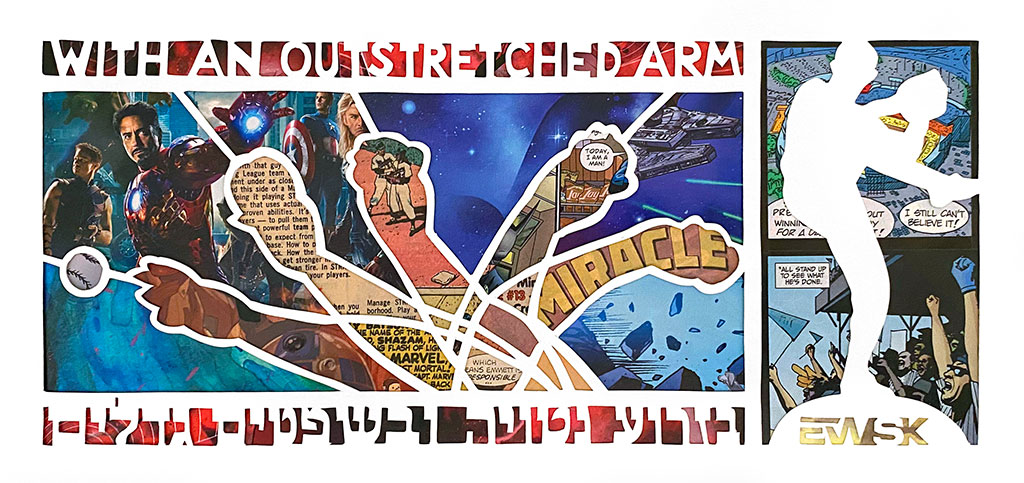
With an Outstretched Arm


"With An Outstretched Arm" is an original papercut I made for Emmett to mark the occasion of him becoming a bar mitzvah January 2021. This papercut is inspired by him, by his Torah portion Va’era, and by the words he shared with his community as he made the transition to Jewish adulthood.

 The central imagery draws on words from Shemot/Exodus 6:6, in which God tells Moses to tell the Israelites, “I will redeem you with an outstretched arm and through extraordinary marvels.” The arm of a pitcher, right to left from wind-up through delivery, delivers a miraculous pitch with an outstretched arm. Within these arms, which are an allusion to Marcel Duchamp’s “Nude Descending a Staircase,”are various comic panels which reference Emmett and the responsibility he is taking on at this special moment.


“Today I am a man,” spoken by teen super hero Robin in a Batman comic, represents the day that this thoughtful, mature boy becomes a man in the eyes of his community.


The rest of the papercut includes cut-up comics which refer to his dreams (such as sports management), his ideals (including the justice and equality embodied by Jackie Robinson), and the moment when a boy becomes a man — noteworthy in the Captain Marvel comic since that hero is actually young Billy Batson, who says the magic word (Shazam) and becomes a grown man and super hero. At right is a pitcher in the moment of wind-up, standing on a pitcher’s mound which includes the EWSK logo commissioned for Emmett for his bar mitzvah — and behind that silhouette (the outline of Sandy Koufax, in one of the many references to the Dodgers in this papercut, sacred to Emmett and his family) we find references to the marvels and miracles of the Torah portion (“I still can’t believe it!”) and to Emmett’s special day (“All stand up to see what he’s done.”). Throughout the work are additional super heroes, embodying the ideals that Emmett chooses to live up to, as well as references to moments public and private.


Comics in the papercut include:

• The All-Star Story of the Dodgers (1979)
• American Flagg #6 (March 1984) — Emmett
• Batman: The Widening Gyre #1 (October 2019) — “Today I am a man.”
• Bucky Barnes: The Winter Soldier #1 (December 2014)
• Bullseye: Perfect Game #2 (February 2011) —”All stand up to see what he’s done.”
• Decorum #2 (June 2020)
• Justice League Special Featuring Mister Miracle #1 (1989) — #13 and “Miracle”
• Los Angeles Dodgers: The Legend of the Blue Knight (April 1997) —”I still can’t believe it!”
• Power Pack #13 (August 1985)
• Shazam! Power of Hope (November 2000)
• Shazam! #2 (April 1973) —”Shazam” and “Marvel”


Sunday, November 29, 2020

Arella Whirls – Commission at Sinai


"Arella Whirls" is a papercut commission made for Stephanie Swedlove to mark her conversion to Judaism, the culmination of a ten-year journey.

Torah and Talmud tell us that all Jews were at Sinai at Revelation, to accept the Torah and the covenant with God. All Jewish souls, into the future, today and tomorrow, by birth and by choice, and so on (Talmud Shevuot 39a and Shemot Rabbah 28:6). This papercut is built around Stephanie’s presence at Sinai, even as she now takes the final steps in the conversion process. Judaism also teaches us that all humanity deserves respect and justice, reinforced for us when we were slaves in Egypt, a story which we retell every year at Passover (and continually throughout our lives). This is connected to Stephanie’s drive for justice, trust, and community. This half of her story is represented with our people’s redemption, shown in the parting of the Sea of Reeds, with a path leading to Sinai.

The foundation is made of the purple costume worn by super hero Stephanie Brown, known as Spoiler – it’s where the journey starts. Up through the parted waters, which feature Arrowverse heroes (such as Felicity from Arrow, representing Stephanie’s analytic mind). “Tomorrow” references the teaching that all Jewish souls, past and present, are “right here.” Beyond/above the waves are verses from Devarim/Deuteronomy 29: 9-14, in which we read about all the people and future generations standing at Sinai in acceptance of the covenant.

In front of Mount Sinai we have the Teen Titans, with the voice of the Divine echoing around them. The lightning of God’s voice (based on a Hebrew pun in Shemot/Exodus 20:15) is made of another hero from the Arrowverse, the Flash, and in the clouds that swirl around the mountain like the smoke from a kiln (Shemot/Exodus 19:18) comic captions read “Arella Whirls” and “Arella Turns,” reflecting the joyous dancing of the Israelites after the crossing of the Sea and in acceptance of the Torah. And of course, Arella is Stephanie’s chosen Hebrew name – reflected as well in the shape of Mt. Sinai, an abstract aleph.

Comics in the papercut include:
  • Batgirl Annual #3 (January 2015)
  • Batman: Huntress/Spoiler #1 (May 1998)
  • Blackest Night: The Flash #1 (February 2010)
  • Gotham Underground #2 (January 2008)
  • Justice League of America #46 (August 2010)
  • Shazam: Power of Hope (November 2000)
  • The New Teen Titans #2 (October 1984), #4 (January 1985)
  • Teen Titans #6 (May 2017)

Sunday, March 22, 2020

How Can We Serve God with the Works of Our Hands?

[This post originally appeared on ReformJudaism.org]

This week, as we begin the Book of Leviticus with Parashat Vayikra, we read about the eternal flame in the Temple in Jerusalem — a symbol of God’s Presence amidst the Jewish people. The smoke rising from the altar was a remnant of our communications with God — physical evidence that we had engaged with the Eternal.
Cantor David Berger writes that “As moderns we have fully embraced the transition from Temple service to ‘the service of the heart,’” citing Babylonian Talmud, Taanit 2a:
To love the Lord your God and to serve Him with all your heart” (Deut. 11:13). Which is the service of God that is performed in the heart? You must say that this is referring to prayer.
We could take this to mean that as we no longer make physical sacrifices, rather than serving God with our hands, we serve with our hearts and minds. And yes, we have transformed Judaism — the work of our hands, turning substance into flame and smoke became the work of our minds, turning words into music and praise. But where does that leave our hands? I suggest that we still have the power — and the responsibility — to serve God with our hands.

The altar smoke — “of pleasing odor to the Eternal” (Lev. 2:9) — is akin to a finished work of art created by a painter or sculptor. It is the lingering echo of music after an orchestra plays or the warmth of a room that has been filled with dancers exercising their bodies. A painting is the evidence that we have painted — and art about the Jewish experience is evidence of our efforts to commune with our people across time, and with the Divine.

The Jewish-American artist Barbara Kruger said, “Making art is about objectifying your experience of the world, transforming the flow of moments into something visual, or textual, or musical, whatever.” When we use the work of our hands in concert with the work of our minds, we can transform our personal experience of the world and the Divine into a shared moment — into a part of the continuing conversation that has been part and parcel of Judaism since the Divine creation of the world.

Our history reveals a continuous connection between art and Jewish practice — from the carving of the Ten Commandments in the moments before the first Shabbat at the end of Creation (Pirkei Avot 5:6) to Bezalel leading the Israelites in the building of the desert Mishkan (Ex. 35), to the commandment of hiddur mitzvah, “beautifying the commandments.” In Midrash M’chilta d’ Rabbi Ishmael,it says:
“I shall glorify God in the way I perform mitzvot. I shall prepare a beautiful lulav, beautiful sukkah, beautiful tzitzit, and beautiful tefillin.” (Shirata, Ch. 3). The Talmud adds, “a beautiful shofar and a beautiful Torah scroll which has been written by a skilled scribe with fine ink and fine pen and wrapped in beautiful silks” (Shabbat 133b).
Our hands still can — and must — do the work of connecting us to the Divine. We can paint, draw, weave, cut, carve, and inscribe — in the service of our people and the Eternal. We can tell our story, praise God, and promote the ideals of tzedakah, emet and shalom.

"Altar Flame" and "Altar Smoke"
[click to enlarge]
 In my work as a papercutter I am in constant engagement with this task, cutting up and collaging comic books and other found materials and using them as a lens through which to study Torah and make “paper midrash.” My papercuts “Altar Flame” and “Altar Smoke” are two explorations of this week’s parashah: attempts to find meaning in superseded ritual practices.

Both of these papercuts reflect the connection between the Jewish people and the Divine, in ancient and modern practice. Within the flames rising from the altar can be found Phoenix, a superhero member of the X-Men with godlike powers, as well as Wonder Woman, whose story is one of constant back-and-forth between gods and human beings. Tucked into the sacrificial smoke are comics featuring godlike heroes like Superman and Thor and also very human heroes like Batman. Our narratives about the relationships of these super-powered beings, and how they connect with the people around them, an inform our ideas about our relationship with God. We ask ourselves what it means to communicate directly with the Divine, and for what purpose we praise God with our hands and hearts.

Jews have always made things of beauty — for ritual and observance, and also to inspire people and praise the Divine. The work of our hands is vital to the work of our souls.

Thursday, May 29, 2014

Three Things


I've made a new papercut to donate to this weekend's fundraising auction at the annual Temple Ahavat Shalom gala (Saturday, May 31, 2014).

In Pirkei Avot 1:18 we read, "Rabbi Shimon ben Gamliel tells us that the world stands upon three things: truth, justice, and peace." This papercut takes as its inspiration the journeys of friendship and giving that have sustained Mindy & Dave and Debbie & Scott, being honored at this year's gala — the ideals that make them who they are, and their commitment to tikkun olam... to fixing the world that they see on their travels.

In this papercut the world is represented supported on a foundation of these three ideals, rendered in papercut Hebrew: emet, tzedek, and shalom. It is titled "Three things," and it's backed with cut-up comics including:
The Infinite Horizon (#5, Oct 2011)
The Infinite Vacation (#5, Jan 2013)
Batman/Superman (#8, Apr 2014)
Superman (#23.3, Nov 2013)
Wonder Woman (#23.2, Nov 2013)
Justice League Europe (#2, May 1989)
Nextwave (#1, 2006)
Details on the gala can be found on the web here. If you're interested in bidding in absentia, please email here or call (818) 360-2258.


Three things
16" x 20"
Mixed media
2014

Thursday, March 6, 2014

Super Heroes, Holy Land:
"Altar Flame" and "Altar Smoke"

These are two of the pieces in my current show, "Super Heroes, Holy Land!" now showing at UCLA Hillel's Dortort Gallery in Los Angeles – on the left is "Altar Flame" and on the right, "Altar Smoke." The originals each measure 24" x 36", though 20" x 30" prints are available in my online store.

Details on each are below – if you want to see them in person, check out the show: open through April 21 (extended!) at UCLA Hillel's Dortort Gallery in Los Angeles, at 574 Hilgard Avenue; call 310-208-3081 for hours or click here for details.

-----

Altar Flame
24" x 36"
Mixed media
2013

The eternal flame on the altar was a symbol of God’s continuing presence with the Jewish people, and people from across the land would journey to Jerusalem during the three festivals — as these sacrifices could only be fulfilled in this one spot. The presence of this flame and the sacrifices that were made on the altar were a very physical process that we have since replaced with the work of our minds and the recitation of words, hence the inclusion of parts of the Life Science Library volume titled, The Mind.
Includes:
  • 300 #2 (Jun 1998)
  • 5 Days to Die #2 and #5 (Sep 2010)
  • Automatic Kafka #2 (Oct 2002) and #3 (Nov 2002)
  • Avengers vs. X-Men #1 (Jun 2012)
  • The Infinite Horizon #6 (Nov 2011)
  • Paradise X #8 (Feb 2003)
  • Ten Grand #3 (Jul 2013)
  • Wonder Woman #44 (Jul 1990)
  • X-Infernus #1 (Feb 2009)
  • X-Men #199 (Nov 1985) 
  • Life Science Library: The Mind. Ed. by John Rowan Wilson. Time-Life Books, Virginia (1980).

-----

Altar Smoke
24" x 36"
Mixed media
2013

The smoke rising from the altar at the Temple’s Holy of Holies was the physical remnant of communicating with God in ancient times – it was evidence that we had engaged with the Eternal. The smoke would bring sweet smells up to the very anthropomorphized God that could only be addressed in this way, in this particular spot. The smoke represents the direct line of communication with God; Jerusalem is still considered the place with that direct connection to God.
Includes:
  • Astonishing X-Men #26 (Oct 2008)
  • Automatic Kafka #1 (Sep 2002) and #4 (Dec 2002)
  • Batman: The Black Glove (2008)
  • The Infinite Horizon #4 (Apr 2009) and #6 (Nov 2011)
  • Judenhass (2008)
  • Marvels: Eye of the Camera #1 (Feb 2009)
  • The Mighty Thor #399 (Jan 1989)
  • The New Mutants #27 (May 1985)
  • ROM #31 (Jun 1982)
  • Superman #77 (Mar 1993) and #18 (May 2013)
  • X-Men Legacy #246 (May 2011) 
  • The World of Ancient Israel. David Meilsheim. Tudor Publishing Company, New York (1973).

Tuesday, December 17, 2013

On Being the URJ Biennial Artist-in-Residence


What an incredible experience. Five thousand Reform Jews from around the world (mostly from North America) gathering together in San Diego for the 2013 URJ Biennial, where I was the artist-in-residence.

Getting started in my mobile studio.
I had three things to get done: the first was to create an original artwork inspired by Biennial, created entirely at Biennial in the kikar (the “public square”). The second was to share my process with anyone and everyone who came by my mobile studio, and the third was to lead a workshop in papercutting and help people make their own art.

The first piece cut.
I’d never had to work in public in this way before – and it was certainly a challenge. It’s one thing to be working in the safety of my studio, where I can make decisions (and mistakes) on my own and not worry about how messy the process can be. To be exposed like I was, with people watching me sketch and cut and search and paste... it was unnerving at times, but energizing at others. The hardest part might have been finding enough time to keep working on the papercut while talking to so many people who wanted to hear about my process.

Left, the mountain begins to take shape. Right: one of the first background pieces.

As for the workshop: three dozen people joined me to express ourselves through the cutting of paper. Margaret and Lou and Shoshana and Joe and Robin and Wilma and Heidi... so many wonderful budding artists. It was both exhausting and invigorating. We had four hours together, and I am so proud of the work everyone made.

Photo from the URJ
Photo from the URJ

And somehow it happened: although Wednesday morning I had only a large blank sheet of cold-press watercolor stock, by Saturday night I had completed “Gathering.”


Wednesday I studied and sketched, Thursday I cut paper to create the top layer, Friday I disassembled and then reassembled pieces from comic books and maps and other ephemera to create the background, and Saturday after my workshop I put the last pieces together.

The idea inspiring the piece is simple, really – I came to see the Biennial as a “Sinai moment,” all of us gathered together to worship and receive Torah and study and learn.


As with all of my work, words from Torah informed the piece. In Exodus 19:18 we read, “Now Mount Sinai was all in smoke, for Adonai descended upon it in fire, and the smoke rose like the smoke of a kiln, and the whole mountain trembled violently.” That’s the way I like to think of Revelation – as a kiln. The smoke of God’s presence surrounding the top of the mountain reminds us that we are not just gathering, but creating. We came together to discuss strengthening our movement and building a vibrant and relevant Jewish future.


The mountain itself is built out of the honeycomb iconography of the Biennial, with the riot of colors and textures underneath reflecting the content of the sessions, the sanctity of our prayers, and the specific geography of Biennial. The space surrounding the mountain is made of cut-up books and ephemera, including a dictionary and an encyclopedia, with references to Sinai, San Diego, Torah, music, prayer and the Reform movement.

The completed papercut: "Gathering"
I am grateful to have been given the opportunity to serve as Biennial artist-in-residence; it was a pleasure and a privilege to study and teach and learn and create with this community.

“Gathering” includes these comics (and more) in the background:
  • Action Comics #25 (Jan 2014)
  • Animal Man #2 (Dec 2001)
  • Batman: The Black Glove (2008)
  • Captain Atom #3 (Jan 2012)
  • The Flash: Rebirth #1 (June 2009)
  • Green Arrow #22 (May 2003)
  • Green Arrow and Black Canary #8 (Jul 2008)
  • Green Lantern: Fear Itself #1 (2011)
  • Infinite Vacation #5 (Jan 2013)
  • Invincible Iron Man #25 (Aug 2010)
  • Justice League #1 (Oct 2011)
  • Metamorpho and Aquaman #1 (Oct 2007)
  • Supergirl and the Legion of Super-Heroes #25 (Feb 2007)
  • Testament #3 (Apr 2006)
  • Wonder Woman #10 (Aug 2007)

“Gathering” also includes pieces of the following:
  • The Future of Judaism in America, by Eugene Kohn. (The Liberal Press, New York, 1934.)
  • Union Hymnal, Third Edition. The Central Conference of American Rabbis, New York, 1958).
  • Pathways Through the Bible, by Mortimer J. Cohen. (The Jewish Publication Society of America, New York, 1966).

The final work will hang in the URJ’s New York offices, and for a limited time we are making archival giclée prints available to anyone interested in having a reminder of Biennial for themselves. The prints measure 16” x 20” and will be mailed in an artwork tube; the price is $120.00 (including domestic shipping), and the proceeds are being split with the Union for Reform Judaism. To order, please visit my online store.

Friday, May 3, 2013

"Number Theory"


I'm pleased to be donating a papercut to ANOTHER fundraising auction happening tomorrow – this one being held at Brave New World Comics on Free Comic Book Day (tomorrow, May the Fourth) to support the Newhall Public Library!

"Number Theory" is built on a structure of the ten basic Hindu-Arabic numerals (0123456789), and it's about the power of individuals working together. Each person has their particular strengths and skills and backgrounds, and they become magnified by the presence of others. We can all be heroes, and so the background texture for the cut is a collection of superheroes, representing the strength of diversity.

Interested in bidding? You do NOT have to be present to bid; just call the shop at 661 259 4745!

Number Theory
10" x 18"
Mixed media

Monday, February 25, 2013

"In the Garden"


“In the Garden” was commissioned by a patron in New Zealand — it's a diptych featuring two trees from the Garden of Eden: the Tree of Knowledge and the Tree of Life.

The trees are similar in structure, underscoring the ambiguity of whether these trees were two different trees or, in fact, the same tree — as has been posited by scholars over the years.

On the left, the Tree of Knowledge is backed with cut up texts related to the tree and the knowledge that came from it; it also features small fruits to tempt Eve and Adam. There are glimpses of the Bible, of encyclopedia entries and textbooks — with references to apples, belief, and the traditions that have sprung from this story.

On the right, the Tree of Life is alive with natural greens and browns from cut-up comic books and other textures, featuring three red fruits. The tree is a study of life, for while it is composed of wood and leaves, those are representations on paper which only symbolize those natural elements; and yet, that paper is made from wood, which of course is a more literal backing of the tree’s forms.

Comics used include:
  • Animal Man #3 (January 2012)
  • Azrael #3 (July 2009)
  • Batman #493 (May 1993)
  • Batman: Lovers and Madmen (2008)
  • Daredevil: The Man Without Fear, v2 #56 (March 2004)
  • Flash Annual #2 (1988)
  • Green Lantern Corps #47 (June 2010)
  • JLA: Liberty and Justice (November 2003)
  • The Lone Ranger #25 (January 2011)
  • The Power Company #4 (July 2002)
  • Powerless (2005)
  • Shazam! Power of Hope (November 2000)
  • Teen Titans #4 (December 2003)
  • Trinity #23 (November 2008)
  • Vermillion #4 (January 1997)
  • The Last of the Greats #5 (February 2012)
Other texts used include:
  • Cavins, Dr. Lorimer V., ed. The Wonderland of Knowledge, Volume 1. Publishers Productions, Inc., 1938.
  • Cohen, Mortimer J. Pathways Through the Bible. JPS, 1946.
  • Cohen, The Reverend Dr. A., ed. The Soncino Chumash. Soncino Press, 1947.
  • Emerson, Ralph Waldo. Essays by Ralph Waldo Emerson. Thomas Y. Crowell Company, 1951.
  • Farb, Peter. LIFE Nature Library: Geology. TIME-LIFE Books, 1963.
  • Holst, Bernhart P., ed. World-Scope Encyclopedia, Volume 1. Readers League of America, 1945.
  • Raisin, Dr. Jacob S., Ph.D. The Haskalah Movement in Russia. JPS, 1913.

Tuesday, November 22, 2011

A Thanksgiving Treat:
Batman with Eve


From Elseworlds 80 Page Giant #1, of course.

Wednesday, March 2, 2011

"Reuben" papercut


This is my latest completed papercut, titled "Reuben"; it's the first in a planned series of 12 cuts based on the Twelve Tribes (the papercut is 24" in height; click the image above to see it larger).

Reuben was the oldest son of the patriarch Jacob and matriarch Leah. I've represented the tribe with a mandrake root, based on the words of Bereshit (Genesis) 30:14: "Once, at the time of the wheat harvest, Reuben came upon some mandrakes in the field and brought them to his mother Leah." Mandrakes are a symbol of fertility and their roots often resemble human figures or body parts; Leah had been having difficulty conceiving again, and it is taught that Reuben was trying to help his mother.

The Tribe of Reuben is often represented with the figure of a man, and I've built this mandrake root out of comic book representations of flesh and skin -- hoping to convey the gnarled twistedness of the root and the pliant softness of flesh. Much of the flesh textures come from the Marvel comics character The Sub-Mariner, as an allusion to the words of Bereshit 49:4, in which Jacob calls his son "unstable as water." I won't get into the racy story that figures in the Jacob/Reuben conflict (it's a bit too juicy for this blog), but there's a lot of ambivalence over Reuben's character, and I wanted to express some of that attraction/repulsion with the layers and segments that make up the root.

The blue background the surrounds the root comes from a Batman illustration by Alex Ross -- Batman has his own mother issues, usually represented by a string of pearls at the time of her murder; I liked the conflation of Batman's desire to seek justice for his mother after her death, and Reuben's attempt to find justice for his mother while she still lived.

Thursday, June 10, 2010

"Number Theory: Heroes"


Just completed this piece to submit to Deloitte -- yes, my work life and art life have come together in a weird venn diagram of awesomeness.

So I made this piece specifically for Deloitte, as part of the Deloitte University project -- they're planning to decorate the campus with artwork created by the people of Deloitte. Here's what I said in my submission:
My art is a blending of traditions, using the mythos and imagery of comic books to explore themes of identity and connection to the world around us.

In this piece, which I created specifically for submission to Deloitte University, the papercut is built on a structure of the ten basic Hindu-Arabic numerals (0123456789), symbolizing the outward appearance of an organization built on – and dedicated to – numbers. But of course, Deloitte is much more than that – it is an organization of individuals, who each bring with them particular strengths and skills and backgrounds and make the organization more than the sum of its parts, and more than just about “numbers.” We are, all of us, heroes to ourselves and to others; it’s part of our shared values that we be the best we can be, and that we help others to do the same. And so the background texture for the cut is a collection of superheroes, representing our strength and diversity and commitment to individual performance, positive team dynamics, and joint success.
And yes, I do *love* where I work.