Showing posts with label Hebrew. Show all posts

Thursday, December 3, 2020

"Graphic Jews" and ish Festival

 Had a great time presenting for the third and final installment of the "Graphic Jews" webinar series from ish Festival, HUC Cincinnati, and the Skirball Museum in Cincinnati. If you missed it and you want to catch it on the replay, click here. Meantime, here are some screencaps; we talked about Jewish art, and golems, and comics – some of my favorite topics!


Sharing my "Twelve Tribes" series

Discussing "Wisdom Cries Out in the Streets"

Sharing some of my lockdown golems

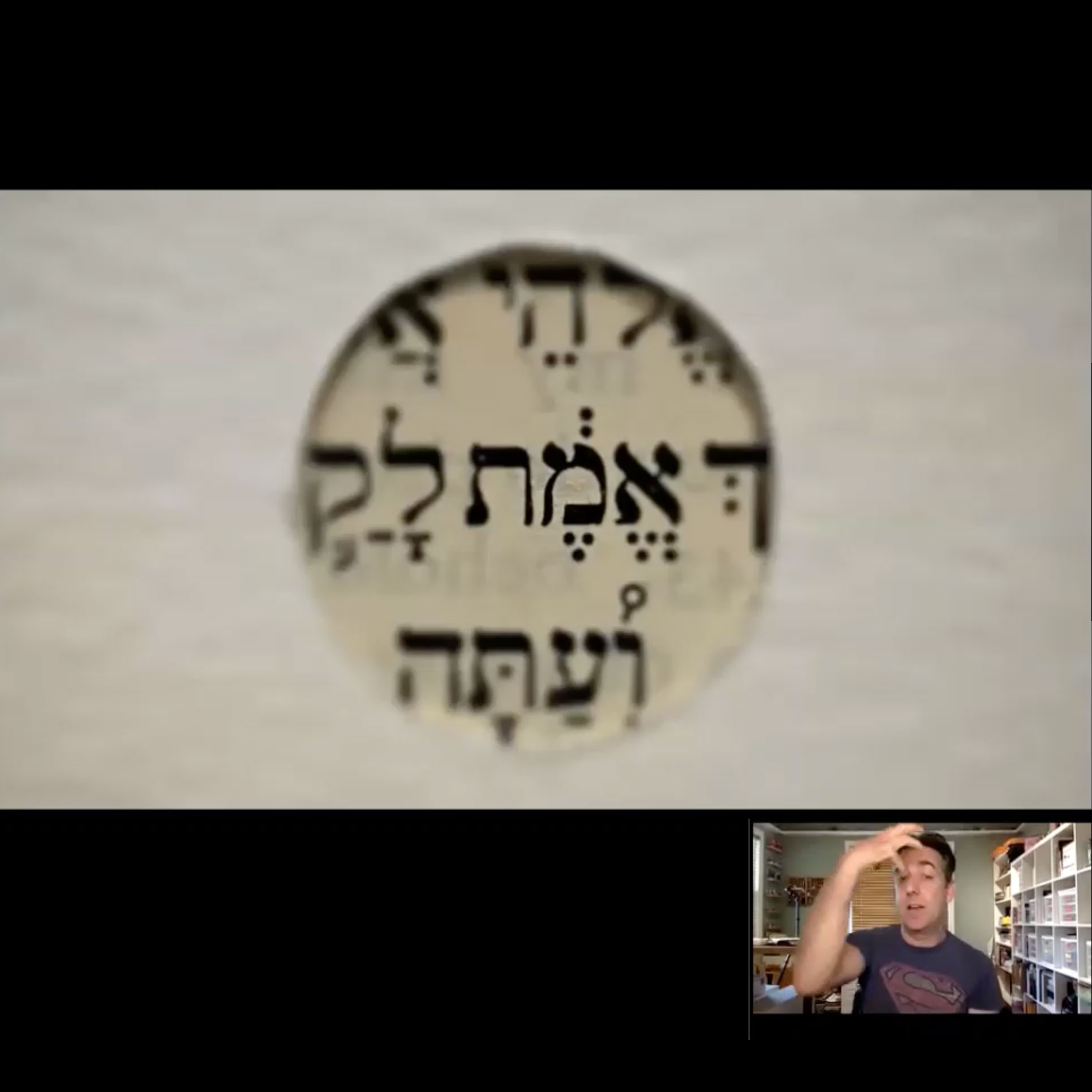
"Emet" (truth) powers the traditional golem

My first golem is made of comics featuring Jewish super hero The Thing

Did a live demo!

Me, ish's Marie Krulewitch-Browne (right), and the Skirball's Abby Schwartz (below)


Wednesday, January 1, 2020

Deep Space Shiviti


“Deep Space Shiviti” is a papercut I created for Rabbi Paul Kipnes in December 2019, commissioned as a birthday present by his family. It is modeled on the traditional Jewish shiviti, a meditative artwork inspired by words from Psalms 16:8: “I have always placed the Eternal before me,” intended to inspire an appropriate frame of mind for prayer and contemplation. The shiviti traditionally incorporates a seven-branched menorah, words drawn from Jewish texts, kabbalah, and other mystical sources; this one also features cut-up comic books.

“Deep Space Shiviti” is a contemporary and personal interpretation of this traditional form, built around a vision from the fourth chapter of the book of Zechariah, which describes a lampstand of gold, feeding into and being fed by two olive trees, one on either side. It is a vision of replenishment and renewal, of resilience and rededication. Surrounded on both sides by the twelve gems of Aaron’s priestly breastplate (an allusion to Rabbi Kipnes’ Hebrew name), the menorah stands in front of the Kotel in Jerusalem, reinvented as a place where everyone stands together for inspiration and connection.

The words and imagery in “Deep Space Shiviti” are drawn from comic books — two kinds in particular: Star Trek comics and comics featuring Jewish super heroes. The name “Deep Space Shiviti” is itself a reference to Rabbi Kipnes’ guest appearance on an episode of “Star Trek: Deep Space Nine.”


There are allusions to Rabbi Kipnes’ family and community; to places close to his heart; to his roles as husband, father, rabbi... and as a man true to himself. The papercut contains camp cabins, maps of wondrous places, and images of light and inspiration.

There is the Bat Signal, another lighted symbol of hope; Yggdrasill, the “world tree” whose roots and branches support and connect the fabled Nine Realms; and Deep Space Nine, a home to a diverse group of people with different backgrounds who are united in a common cause (and also of special meaning to Rabbi Kipnes). The papercut also features multiple Jewish super heroes, including Kitty Pryde and Benjamin “The Thing” Grimm — the former with her “Hold Fast” tattoo and the latter holding his Star of David necklace; Black Canary, whose commitment to heroism is matched by her commitment to handing down her super heroic beliefs and practices to the next generation; and Spider-Man, who reminds us that with great power must also come great responsibility.

The papercut includes:
All-New X-Men #13 (Aug 2013)
Astonishing X-Men #36 (Apr 2011)
Batwoman #3 (Jan 2012), #16 (Mar 2013)
Booster Gold #19 (Jun 2009)
The Life of Captain Marvel #1 (Oct 2018)
Dazzler #38 (Jul 1985) – “Light”, #1 (Aug 2018)
Excalibur #66 (Jun 1993)
Fantastic Four #56 (Aug 2002)
The Legion of Super-Heroes #503 (Sep 1983)
Tales of the Legion of Super-Heroes #352 (Oct 1987)
Lumberjanes: A Bird’s Eye View (Dec 2017
Marauders #2 (Jan 2020)
Noble Causes: Distant Relatives #2 (Sep 2003)
The Ray #1 (May 1994)
Scarlet #8 (May 2016)
Star Trek Movie Special: Star Trek III (1984)
Star Trek: The Next Generation #24 (Oct 1991)
Star Trek: Deep Space Nine #1 (Aug 1993)
Star Trek: Year Five #1 (Apr 2019)

Friday, July 6, 2018

All Hands on Deck: Fingerprint Mosaics at Camp Newman


You may have already read the whole story – how this summer at URJ Camp Newman my wife (Rabbi Shawna B2) and I led campers in the creation of new tallitot (prayer shawls) for the camp, one session at a time.

Each tallit is a fingerprint mosaic, where each camper had a chance to add their personal mark. The idea was that fingerprints are personal, but combined together they create a mosaic-like pattern, creating a communal work rather than an individual one — and that it would take the fingerprints of the whole eidah (session) to create a finished work. (And a big thank-you to Rabbi Laura Novak Winer, who worked with us on all of these talliot!)

If you haven't read that post, please go check it out on the camp blog: https://campnewman.org/2018/07/06/all-hands-on-deck-fingerprint-mosaics-at-camp-newman/. But here's something the post  doesn't have: pictures of all of the finished tallitot, which we're pleased to share here.


Avodah is dedicated to community involvement and social justice,
so their tallit is a rainbow flag they took to the 2018 Pride Festival


Tzofim's tallit is a Jerusalem skyline, complete with turrets and archways.

Rishonim is out "nature" session, so they made a tree – with a branch for each of their twelve "tribes."

Bogrim made the seven species: grapes, dates, wheat, barley, figs, olives, and pomegranates.

The CITs are celebrating "C-CHAI-T" this year so their handprints surround a chai, with advisors' hands blessing them from the sides. (This shot is the ALMOST-done tallit; we were waiting for two late arrivals to complete it.)
Hagigah's tallit is an abstract representation of waves,
in honor of Camp Newman's first summer "by the bay."
Faculty and staff made a tallit as well – "Miriam's Well," with a quote from Amos 5:24:
"Let justice roll down like water, and righteousness like an ever-flowing stream."

And if you want more information on what we can do with your community, check us out on the web at www.PaperMidrash.com.

Social Justice Art at Camp Newman

The week before camp started this summer, Twitter exploded with Bible quotes protesting the treatment of immigrants seeking asylum in the U.S. So much of our Torah seems made for protest signs — because so much of our people’s story is about rejecting the status quo and looking toward a better future.

“Justice; justice you shall pursue!”
“Do justice, love mercy, walk humbly before God!”
“Love your neighbor!”
“Do not stand idly by!”

So when asked by the URJ Camp Newman director to come up with an activity for the Avodah campers — a session dedicated to community service and social action — Rabbi Shawna and I decided to try something new: social justice art.

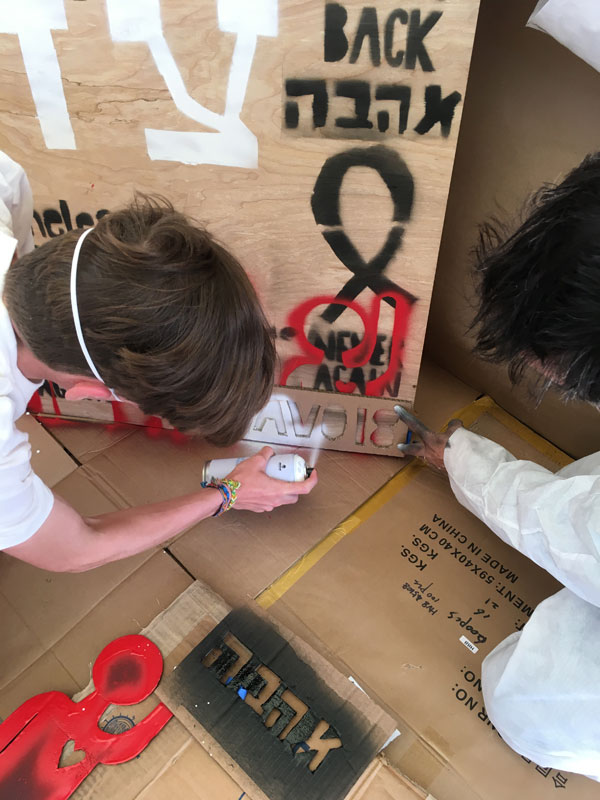
We already had a bunch of knives, and plenty of cardboard ready to be upcycled, so we just needed a few more things: breathing masks, gloves, and LOTS OF SPRAY PAINT.

Day one was learning how to use the tools: getting comfortable cutting cardboard stencils and building spray booths to safely (and cleanly) practice stenciling — and then doing some test stencils.


As with every art workshop we lead, this one relied heavily on Jewish text and context. We introduced the idea of Judaism as a religion that encourages questions, and questioning authority — of never accepting things as they are, but advocating for a better world, loudly and clearly. We emphasized that protest does not have to be limited to complaining and criticizing, but can be about inspiring action and change. We combined that with the traditional role of stencil graffiti as a way to quickly and clearly communicate messages to a wide audience, and soon the campers were turning their ideas about the world around them into stencils.


We shared with them Banksy’s quote: “If graffiti changed anything, it would be illegal.” Because yes, art can be powerful and dangerous. But we weren’t planning to turn these campers into vandals — we encouraged them to consider how their art could be shared legally: on signs pasted up around camp with removable painter’s tape, as images to be shared digitally, and as signs and posters to amplify their voices at rallies. For instance, every summer Avodah marches in the San Francisco Pride Parade and attends the AIDS Walk San Francisco — and they created art to share those messages. We struggled with how to share Jewish text, and we were surprised with the teens’ discomfort at listing book, chapter and verse; they felt that this was Christian way to share text and instead chose to center their work around the concept of tzedek — “justice” — with the other messages placed around it.


The messages they chose to make into stencils were powerful and familiar:

“Nevertheless She Persisted”
“Never Again”
“She Grabs Back”
“Ahavah”
“Our Time”


It was fascinating to see how they created their personal messages, but also how they combined those messages together to make a plywood “wall” to share with camp — integrating their messages and imagery into one big collaboration. They chose to overlay their messages with people raising their hands to step up, their hearts united in love.

We also had the opportunity to create protest art with campers from the Hagigah session, which is focused on the arts; I was joined at these sessions by Rabbi Laura Novak Winer, the session rabbi, who taught about Judaism being a protest religion and how even our monotheism was countercultural. These campers had more time to experiment with the tools, and to explore more messages — and they wowed us as well.


“Love is Love”
“Endure”
“Dance Out of the Closet”
“Shalom”
“Compromise”
“We Are All Equal”
“We Fight”


They, too, had individual pieces that were even more powerful when combined with the work of their friends and peers — creating a plywood triptych for display in the annual Hagigah Peachy Levy Arts Festival at the end of their session. I am so inspired by these campers, who are finding their voices and learning to make themselves heard.


Sunday, October 16, 2016

You May Kiss the Groom – Both of You!


Mazal tov to Meir Bargeron and Jon Tam! I am so pleased to share with you the Bargeron-Tam ketubah, which I created for them — and they just signed it and got married this past weekend!

According to Kabbalah the four days between Yom Kippur and Sukkot are especially holy days, and excellent for a wedding — and Jon and Meir got married during that auspicious time. For that reason, their ketubah is a hupah and a sukkah. The sukkah has many parallels with the hupah, after all: both represent dwellings, and are places of peace and comfort. We invite guests to join us for both, and we celebrate with food and drink. The top of the ketubah is the sukkah’s lattice roof, filled with texts about marriage taken from comic books and the ketubah text.


The lattice incorporates texts from comic books and from traditional texts referenced in the ketubah text – here, from the book of Bereshit (Genesis).
Overflowing with promises!

Here's where the ketubah gets its name from – text from X-Men #51 (August 2012). Also, text from the book of Hosea, referenced in the ketubah text.


Grapes and pomegranates climb alongside the English text: symbols of joy and family, and a reference to the wine Meir and Jon share under the hupah.


The section in between the English and Hebrew texts is made of tea leaves, specifically those used to make dong ding oolong tea, which the couple had in a tea ceremony prior to entering into the hupah. Blazing beside the Hebrew is a havdalah candle with two wicks joining into one flame; this represents the Havdalah service Jon and Meir included as part of their wedding, and the colors are those of the silk hupah under which they make their vows. The candle is also a reference to these words from the Baal Shem Tov:

From every human being there rises a light that reaches straight to heaven, and when two souls that are destined to be together find each other, the streams of light flow together and a single brighter light goes forth from that united being.


The ketubah is made of cut-up comic books, in particular wedding-themed issues — and many pieces are from mainstream superhero comics’ first same-sex wedding, in Astonishing X-Men #51. Comics in the ketubah include:
  • Astonishing X-Men #51 (August 2012) — wedding of Jean-Paul Beaubier (Northstar) and Kyle Jinadu
  • The Justice League of America #121 (August 1975) — wedding of Adam and Alanna Strange
  • The Legion of Super-Heroes Annual #2 (1983) — wedding of Val Armorr (Karate Kid) and Princess Projectra
  • Superman: The Wedding Album #1 (December 1996) — wedding of Clark Kent (Superman) and Lois Lane
  • Ultimate Comics X-Men #22 (April 2013)
  • The Wedding of Deadpool #1 (March 2016)
  • X-Men Legacy #255 (November 2011)

Sunday, September 4, 2016

Home is a Road: the Greenwald-Hromadka Ketubah


Mazal tov to Adam and Anne! I was so honored that they asked me to make their ketubah, and my wife and I were so pleased to celebrate with them today as they became husband and wife.


The Greenwald–Hromadka ketubah is a labyrinth: an intertwined collection of paths with infinite choices, and the potential for serendipity and coincidence. A labyrinth is designed for discovery; wandering is the intent, and every path leads to the center. A labyrinth encourages you to walk slowly, to pause here and there, to experience the path instead of just focusing on a destination. In Bereshit we read about Jacob wandering and wrestling with an angel; afterward, he realizes that he has found holy ground. That’s Adam and Anne’s story: walking the multitude of paths until they met, realizing they had found something holy, and then wandering those paths together. For Adam and Anne, home is a road.


The ketubah text is surrounded by this labyrinth, built in a palette of blues, purples, and reds. These are the colors of the mishkan — the desert tabernacle constructed by Bezalel and the Jewish people during their desert wanderings; it was a focus for worship and a work of art in itself. These colors also reference grapes (for wine and joy) and pomegranates (for fertility and the mitzvot). The building of the mishkan is a wonderful metaphor for the couple, combining Adam’s commitment to serving the Jewish community through his rabbinate, and Anne’s drive to bring beauty to the world through creation and curation; accordingly, verses from Shemot/Exodus chapter 26 are incorporated into the labyrinth.


The colorful spaces surrounded by and created by the wandering paths are cut-up comic books representing Adam and Anne — their courtship, their couplehood, and the life they are planning together. Adam’s intelligence and focus are found in the characters of Professor X (leader of the X-Men) and Mr. Terrific (the third smartest man in the world), and his passion is seen in his namesake Adam Strange, who travels between worlds to be with the love of his life. Anne’s creativity and her gypsy and cajun roots are represented in Gypsy (a member of the Justice League of America) and Rogue (a member of the X-Men, whose real name is Anna Marie), and the power of her love is personified by Star Sapphire.


The ketubah is filled with speech bubbles that relate to the couple and their wedding, and glimpses of the superheroes that stand in for them; there are allusions to many of their stories, including references to Los Angeles — which Adam and Anne describe as a key player in their relationship.


The Greenwald–Hromadka ketubah is made of cut-up comic books; this is a partial listing:

  • All-Star Superman #2 –Jan 2006
  • Archie #1 – May 2016
  • ETC #1 – 1989
  • Green Lantern: New Guardians #15 – Feb 2003
  • Justice League of America #121 – Aug 1975; #234 – Jan 1985; #39 – Jan 2010
  • Justice Society of America #14 – May 2008
  • Loki #1 – Dec 2010
  • ODY-C #1 – Nov 2014
  • Promethea #31 – Oct 2004
  • Rogue #3 – Mar 1995; #4 – Apr 1995)
  • Runaways #15 – Jun 2006; #16 – Jul 2006
  • Spider-Man Loves Mary Jane #15 – Apr 2007
  • Strange Adventures #1 – May 2009; #2 – Jun 2009
  • Superman: The Wedding Album #1 – Dec 1996
  • Swamp Thing #63 – Aug 1987
  • Tales of the Teen Titans #50 – Feb 1985
  • The Wedding of Deadpool #1 – Mar 2016
  • Ultimate X-Men #53 – Jan 2005
  • Wonder Woman #23.2 – Nov 2013
  • X-Factor #14 – Mar 1987
  • X-Men ‘92 #1 – Aug 2015
#adamandanne2016