Showing posts with label Torah. Show all posts

Sunday, January 31, 2021

With an Outstretched Arm


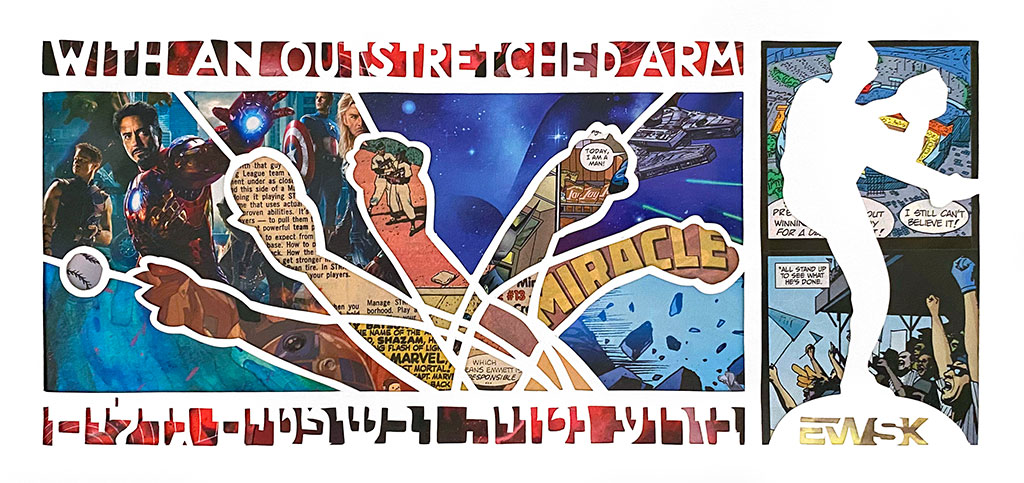
"With An Outstretched Arm" is an original papercut I made for Emmett to mark the occasion of him becoming a bar mitzvah January 2021. This papercut is inspired by him, by his Torah portion Va’era, and by the words he shared with his community as he made the transition to Jewish adulthood.

 The central imagery draws on words from Shemot/Exodus 6:6, in which God tells Moses to tell the Israelites, “I will redeem you with an outstretched arm and through extraordinary marvels.” The arm of a pitcher, right to left from wind-up through delivery, delivers a miraculous pitch with an outstretched arm. Within these arms, which are an allusion to Marcel Duchamp’s “Nude Descending a Staircase,”are various comic panels which reference Emmett and the responsibility he is taking on at this special moment.


“Today I am a man,” spoken by teen super hero Robin in a Batman comic, represents the day that this thoughtful, mature boy becomes a man in the eyes of his community.


The rest of the papercut includes cut-up comics which refer to his dreams (such as sports management), his ideals (including the justice and equality embodied by Jackie Robinson), and the moment when a boy becomes a man — noteworthy in the Captain Marvel comic since that hero is actually young Billy Batson, who says the magic word (Shazam) and becomes a grown man and super hero. At right is a pitcher in the moment of wind-up, standing on a pitcher’s mound which includes the EWSK logo commissioned for Emmett for his bar mitzvah — and behind that silhouette (the outline of Sandy Koufax, in one of the many references to the Dodgers in this papercut, sacred to Emmett and his family) we find references to the marvels and miracles of the Torah portion (“I still can’t believe it!”) and to Emmett’s special day (“All stand up to see what he’s done.”). Throughout the work are additional super heroes, embodying the ideals that Emmett chooses to live up to, as well as references to moments public and private.


Comics in the papercut include:

• The All-Star Story of the Dodgers (1979)
• American Flagg #6 (March 1984) — Emmett
• Batman: The Widening Gyre #1 (October 2019) — “Today I am a man.”
• Bucky Barnes: The Winter Soldier #1 (December 2014)
• Bullseye: Perfect Game #2 (February 2011) —”All stand up to see what he’s done.”
• Decorum #2 (June 2020)
• Justice League Special Featuring Mister Miracle #1 (1989) — #13 and “Miracle”
• Los Angeles Dodgers: The Legend of the Blue Knight (April 1997) —”I still can’t believe it!”
• Power Pack #13 (August 1985)
• Shazam! Power of Hope (November 2000)
• Shazam! #2 (April 1973) —”Shazam” and “Marvel”


Sunday, November 29, 2020

Arella Whirls – Commission at Sinai


"Arella Whirls" is a papercut commission made for Stephanie Swedlove to mark her conversion to Judaism, the culmination of a ten-year journey.

Torah and Talmud tell us that all Jews were at Sinai at Revelation, to accept the Torah and the covenant with God. All Jewish souls, into the future, today and tomorrow, by birth and by choice, and so on (Talmud Shevuot 39a and Shemot Rabbah 28:6). This papercut is built around Stephanie’s presence at Sinai, even as she now takes the final steps in the conversion process. Judaism also teaches us that all humanity deserves respect and justice, reinforced for us when we were slaves in Egypt, a story which we retell every year at Passover (and continually throughout our lives). This is connected to Stephanie’s drive for justice, trust, and community. This half of her story is represented with our people’s redemption, shown in the parting of the Sea of Reeds, with a path leading to Sinai.

The foundation is made of the purple costume worn by super hero Stephanie Brown, known as Spoiler – it’s where the journey starts. Up through the parted waters, which feature Arrowverse heroes (such as Felicity from Arrow, representing Stephanie’s analytic mind). “Tomorrow” references the teaching that all Jewish souls, past and present, are “right here.” Beyond/above the waves are verses from Devarim/Deuteronomy 29: 9-14, in which we read about all the people and future generations standing at Sinai in acceptance of the covenant.

In front of Mount Sinai we have the Teen Titans, with the voice of the Divine echoing around them. The lightning of God’s voice (based on a Hebrew pun in Shemot/Exodus 20:15) is made of another hero from the Arrowverse, the Flash, and in the clouds that swirl around the mountain like the smoke from a kiln (Shemot/Exodus 19:18) comic captions read “Arella Whirls” and “Arella Turns,” reflecting the joyous dancing of the Israelites after the crossing of the Sea and in acceptance of the Torah. And of course, Arella is Stephanie’s chosen Hebrew name – reflected as well in the shape of Mt. Sinai, an abstract aleph.

Comics in the papercut include:
  • Batgirl Annual #3 (January 2015)
  • Batman: Huntress/Spoiler #1 (May 1998)
  • Blackest Night: The Flash #1 (February 2010)
  • Gotham Underground #2 (January 2008)
  • Justice League of America #46 (August 2010)
  • Shazam: Power of Hope (November 2000)
  • The New Teen Titans #2 (October 1984), #4 (January 1985)
  • Teen Titans #6 (May 2017)

Sunday, May 31, 2020

Black Lives Matter

Tzedek Tzedek Tirdof – Justice, Justice You Shall Pursue!
(Devarim/Deuteronomy 16:18)

#blacklivesmatter #justiceforgeorgefloyd

I Can’t Breathe
24" x 18"
Mixed media
2020

“I Can’t Breathe” is made of cut-up comic books and inspired by the death of George Floyd – and also the Ten Martyrs of the Jewish tradition, and the “Ayleh Ezkerah” poem from our High Holy Day machzor that reminds us to remember those that died in holy causes. I also referenced the Book of Lamentations – particularly thinking about how we represent and respond to tragedy. I’m also a big fan of Ben Shahn (mid-20th century social realist), and his illustrations are definitely an influence on the final form of this piece. Then, once cut, I filled it with cut-up comics books featuring Black super heroes: the wrongly-convicted Luke Cage, the monarch Black Panther, and the youthful Cloak. The color scheme of the figure is actually inspired by Luke Cage’s traditional super hero outfit. The last element in here that might benefit from explanation is the listing of place names in his shirt – taken from an ad for a series of comic book conventions around the country. I saw “Minneapolis” and instantly decided to incorporate it and the other cities, to represent that this is more than one man in one city, but a tragedy we have seen repeated so many times, to so many people, in so many cities.


UPDATE

Featured in the June 4, 2020, issue of LA Weekly.


Sunday, May 17, 2020

Hineini: A Papercut Commission

Hineini: The Ordination of Meir Bargeron
“Hineini” was commissioned for Meir Bargeron by his husband Jon to mark his 2020 rabbinic ordination from Hebrew Union College-Jewish Institute of Religion.

Designed to complement their ketubah, the commission has at its top a similar lattice-like design, filled with comic book speech bubbles that tell a “Hineini “narrative, a call-and-response to inspire us to action.

The lattice at the top evokes a roof, and matches the top of Meir and Jon's ketubah.

Exodus 40:38 and Numbers 9:15-16 indicate that the Pillar of Fire and Pillar of Cloud which protected the Israelites on their journey through the wilderness were actually one pillar — during the day the cloud was visible, and at night the fire inside was revealed. With this in mind the lattice sits on this singular Pillar of Cloud and Fire, source of Divine protection and symbol of God’s sheltering presence, styled in similar fashion to the Havdalah candle in Meir and Jon’s ketubah. The fire within is also a reference to Kedushat Levi, Exodus, Mishpatim 11, in which we read that serving God through observing the commandments and studying Torah gives satisfaction to God, and we experience God’s satisfaction as a burning fire of enthusiasm and inspiration in our heart — and that the “consuming fire” mentioned in the biblical account of the Revelation at Mount Sinai is not a description of what was visible on the mountain, but rather a reminder of this fire within us.

At the center is Meir as Avram (or perhaps the other way around) — a “Hineini” moment in which Meir gets his calling from the Divine. Inspired by the Torah which Meir has taught in sermons and in his thesis, it evokes the experience of ordination which — though it may not be where expected — is nonetheless transformative. Beneath Meir is a foundation of texts from which he has drawn his teachings: stories of Avraham and Sarah, Jacob becoming Israel, Ruth and Naomi, and more; these texts form the Hebrew word “Hineini.”

The Hebrew word "Hineini" is filled with texts from Rabbi Meir's thesis and sermons.
Beneath the texts are tall stands of wheat and barley in the style of Frank Lloyd Wright stained glass. Wheat and barley are two of the seven species (connecting back to the grapes and pomegranates in Meir and Jon’s ketubah); they are a reference to the fields that Ruth and Naomi gleaned together; and they also allude to the many Jewish texts that use wheat and barley as metaphors for growth and morality. Within the stalks can be found maps which point to the past (Minneapolis), the present (Los Angeles), and the future (Fort Wayne).

Wheat and barley and traditional Jewish metaphors for growth and morality.
The Superman panel in which he proclaims, “It’s me” is from the most recent Superman storyline, in which he reveals his truth to the world: he is both Superman and Clark Kent. In issue 18 he says, “When I show up as Superman, I want to show up representing both parts of me at the same time.” It is a bold story about truth and authenticity. He is declaring his identity and his purpose, and responding to a call for action with his whole self — the perfect story to mark Meir’s rabbinic ordination.

The "social distancing" hand-off.

Comics in "Hineni" include:
Action Comics #687 (June 1993) — “Look! Up in the sky!!”
Blackest Night: The Flash #1 (February 2010)
Bucky Barnes: Winter Soldier #1 (December 2014)
Detective Comics #936 (September 2016) — “There’s a call for you.”
Etc #1 (1989)
Eternals #10 (July 1986) — “I am here.”
Fantastic Four #587 (January 2011)
Flash #0 (October 1994) — Story called “the beginning of tomorrow”
The Flash: Rebirth #1 (June 2009)
The Flash #1 (June 2010)
JLA Secret Origins (November 2002)
Justice League International #35 (February 1990)
Kabuki: Reflections #6 (June 2006)
Secret Origins #7 (October 1986) — “Oh...My...God...!”
Shazam: The Power of Hope (November 2000)
Silver Star #1 (February 1983) — Jack Kirby
Superman: Peace on Earth (January 1999) — Krypto (for Charlie)
Superman #18 (February 2020) —Superman reveals his truth
Superman: Heroes #1 (April 2020) — “It’s me.”
Ultimate X-Men #63 (November 2005)
Texts include:
Genesis 12:1 — “Lech Lecha”
Genesis 17:5 — Avram becomes Avraham
Genesis 32:29 — Jacob becomes Israel
Exodus 3:4 — “Hineini”
Mah Tovu — Jacob’s tents
Exodus 18:19 — Yitro and Moses
Ruth 1:16 — “Wherever you go, I will go with you”

And today we had a virtual gathering over Zoom to celebrate Meir's ordination, at which the commission was presented. Mazal tov, Rabbi Meir Bargeron!


Sunday, March 22, 2020

How Can We Serve God with the Works of Our Hands?

[This post originally appeared on ReformJudaism.org]

This week, as we begin the Book of Leviticus with Parashat Vayikra, we read about the eternal flame in the Temple in Jerusalem — a symbol of God’s Presence amidst the Jewish people. The smoke rising from the altar was a remnant of our communications with God — physical evidence that we had engaged with the Eternal.
Cantor David Berger writes that “As moderns we have fully embraced the transition from Temple service to ‘the service of the heart,’” citing Babylonian Talmud, Taanit 2a:
To love the Lord your God and to serve Him with all your heart” (Deut. 11:13). Which is the service of God that is performed in the heart? You must say that this is referring to prayer.
We could take this to mean that as we no longer make physical sacrifices, rather than serving God with our hands, we serve with our hearts and minds. And yes, we have transformed Judaism — the work of our hands, turning substance into flame and smoke became the work of our minds, turning words into music and praise. But where does that leave our hands? I suggest that we still have the power — and the responsibility — to serve God with our hands.

The altar smoke — “of pleasing odor to the Eternal” (Lev. 2:9) — is akin to a finished work of art created by a painter or sculptor. It is the lingering echo of music after an orchestra plays or the warmth of a room that has been filled with dancers exercising their bodies. A painting is the evidence that we have painted — and art about the Jewish experience is evidence of our efforts to commune with our people across time, and with the Divine.

The Jewish-American artist Barbara Kruger said, “Making art is about objectifying your experience of the world, transforming the flow of moments into something visual, or textual, or musical, whatever.” When we use the work of our hands in concert with the work of our minds, we can transform our personal experience of the world and the Divine into a shared moment — into a part of the continuing conversation that has been part and parcel of Judaism since the Divine creation of the world.

Our history reveals a continuous connection between art and Jewish practice — from the carving of the Ten Commandments in the moments before the first Shabbat at the end of Creation (Pirkei Avot 5:6) to Bezalel leading the Israelites in the building of the desert Mishkan (Ex. 35), to the commandment of hiddur mitzvah, “beautifying the commandments.” In Midrash M’chilta d’ Rabbi Ishmael,it says:
“I shall glorify God in the way I perform mitzvot. I shall prepare a beautiful lulav, beautiful sukkah, beautiful tzitzit, and beautiful tefillin.” (Shirata, Ch. 3). The Talmud adds, “a beautiful shofar and a beautiful Torah scroll which has been written by a skilled scribe with fine ink and fine pen and wrapped in beautiful silks” (Shabbat 133b).
Our hands still can — and must — do the work of connecting us to the Divine. We can paint, draw, weave, cut, carve, and inscribe — in the service of our people and the Eternal. We can tell our story, praise God, and promote the ideals of tzedakah, emet and shalom.

"Altar Flame" and "Altar Smoke"
[click to enlarge]
 In my work as a papercutter I am in constant engagement with this task, cutting up and collaging comic books and other found materials and using them as a lens through which to study Torah and make “paper midrash.” My papercuts “Altar Flame” and “Altar Smoke” are two explorations of this week’s parashah: attempts to find meaning in superseded ritual practices.

Both of these papercuts reflect the connection between the Jewish people and the Divine, in ancient and modern practice. Within the flames rising from the altar can be found Phoenix, a superhero member of the X-Men with godlike powers, as well as Wonder Woman, whose story is one of constant back-and-forth between gods and human beings. Tucked into the sacrificial smoke are comics featuring godlike heroes like Superman and Thor and also very human heroes like Batman. Our narratives about the relationships of these super-powered beings, and how they connect with the people around them, an inform our ideas about our relationship with God. We ask ourselves what it means to communicate directly with the Divine, and for what purpose we praise God with our hands and hearts.

Jews have always made things of beauty — for ritual and observance, and also to inspire people and praise the Divine. The work of our hands is vital to the work of our souls.

Tuesday, January 21, 2020

Men of Steel and Women of Valor

This fall I opened a new exhibition at The Temple Museum of Jewish Art, Religion, and Culture in Cleveland called "Men of Steel and Women of Valor," and I've been keeping you posted here (and on Facebook, and Twitter, and Instagram) but as the exhibition comes to a close it seemed appropriate to put everything up in one place – right here on my blog. (You can also read about it in The Forward or the Cleveland Jewish News.)
Standing in the gallery – in my Superboy shirt, of course.


At the heart of the exhibition is a series of large portraits made of cut-up comic books featuring Superman and Lois Lane, Daredevil and Elektra, the Fantastic Four — transformed into the biblical patriarchs and matriarchs, as well as modern figures. These portraits are a nod to the Jewish custom of inviting guests into one’s sukkah during the fall festival of Sukkot, since we opened the exhibition just before Sukkot. In fact, Rabbi Shawna and I went to The Temple-Tifereth Israel for a Paper Midrash weekend to coincide with the exhibition, praying and teaching and creating all weekend with the community.

Rabbi Shawna and I led a bunch of papercutting workshops during our Paper Midrash weekend

We led a number of projects to create new art for the walls of the TTTI sukkah

Teaching in "the birthplace of Superman"


The exhibition focused heavily on Superman, created in Cleveland in the 1930s by two Jews, Jerry Siegel and Joe Shuster — portraits of whom are included in the show, made of cut-up Superman comics from the past 90 years. You can see the whole show online in this PDF catalog, or check out the pix below.
"Abraham: Ignition" is made with cut-up Fantastic Four comics featuring patriarch Reed Richards

"Sarah: Forward" is made with cut-up Fantastic Four comics featuring matriarch Sue Storm Richards

"Isaac: Hurt" is made of comics featuring blind vigilant super hero Daredevil

"Rebekah: Someone" is made of comics featuring ninja badass Elektra

"Jacob:Disguise" is made of Clark Kent comics (and a little bit of Loki)

"Leah: Suppress" is made of comics featuring Lois Lane (and so is her sister)

"Rachel: Answers" is made of comics featuring Lois Lane (and so is her sister)
It also included portraits of Golda Meir, Israel’s first female prime minister, and Sally Priesand, America’s first female rabbi. The portraits share the walls with landscapes of Jerusalem, stories of fire and water and cloud, and explorations of the Mishnah — all made out of cut-up comic books.

“Siegel: Chutzpah” is a portrait of Jerry Siegel, the writer who co-created Superman. Siegel is represented with cut-up comics featuring some of my favorite Superman writers from the past 90 years.

“Shuster: Action” is a portrait of Joe Shuster, the artist who co-created Superman, Shuster is represented with cut-up comics featuring some of my favorite Superman artists from the past 90 years.

“Priesand: My Turn” is a portrait of the first woman to be ordained as a rabbi in the United States, Sally Priesand.

“Meir: Fight” is a portrait of Golda Meir, the first woman to serve as Prime Minister of Israel.


You can see the whole show online in this PDF catalog. For more information on our residencies and workshops, visit PaperMidrash.com.


Thursday, March 7, 2019

Paper Midrash in the Windy City

Chillin' in Chicago at Cloud Gate (a.k.a the Bean)

We were worried about the cold. The temperature was going to be measured in single digits and, like true Southern Californians, we put on warm jackets when it dips below 65. We were concerned whether people would brave sub-freezing weather to make paper midrash with us... but they did! And it was great!

We led two workshops at Congregation Etz Chaim in Lombard, Illinois; one for adults and one for teens. The adults came for an evening of Havdalah, a little nosh, some teaching on Midrash, and cutting up comic books. Chicagoans are not stopped by cold weather; we had a big crowd, part of the vibrant adult education program at Etz Chaim.

Isaac teaching at Congregation Etz Chaim (and some participant artwork)

It was clear that participants were drawing on what they had studied in Melton and other programs; most participants were already familiar with what midrash is and they were ready to create their own.


Rabbi Shawna teaching at Congregation Etz Chaim (and some participant artwork)
The participants made some beautiful papercut explorations of the creation story in Torah and Midrash. Proving that pop culture is not just for kids, one couple even stumped Isaac with their favorite villain.

We got some great feedback from the group, like this: “Paper Midrash was fantastic! I love that we got to make a piece of art. I also enjoyed learning about the different types of interpretations from Torah, stories that fill in the gaps versus how Torah is put into practice. The presenters brought great energy and knowledge.”


Sunday morning we worked with the CEC high school teens. We brought lots of Spiderverse and Captain Marvel for the teens to work with and — again — we were pleased to see the depth of their designs and how even in working with the same story, no two designs were alike.

A beautiful place to teach teens about Midrash and art

More teen papercut artwork

In both groups there were multiple interpretations of a midrash in Talmud that says that trees talk to each other. We wondered if it was the experience of the seasons (something we don’t have the same way in California) that had people aware of the natural cycle of spring and  eagerly awaiting the the regrowth of trees.

Posing with the teen artists (and some more teen artwork)

We also led a workshop for the Jewish Federation and Jewish United Fund of Greater Chicago, at a fabulous communal space in the suburbs called Sketchpad, where a bunch of Jewish organizations share space for creative (and “regular”) pursuits.

Sketchpad was an incredible place to teach and create

We were so impressed with the concept for the space and how it was used; it was great to be able to work with talented and enthusiastic Jewish educators from different organizations, all under one roof.

With the group from Jewish Federation and Jewish United Fund of Greater Chicago

We loved learning about the space and the Jewish community in Chicago as much as we loved sharing midrash with the group. We always begin the creative part of our workshops with the blessing for creating art from On the Doorposts of Your House and were thrilled to introduce this prayer to Jewish educators, who were excited to bring it back to their own students.


Want more information about bringing Paper Midrash to your community? We’re currently scheduling residencies and workshops for the 2019-2020 academic year; contact us at info@papermidrash.com for details.

Friday, January 18, 2019

Making Art and Talking Comics at Yavneh Day School


Rabbi Shawna and I had the privilege of visiting Yavneh Day School this week, where we we led a Paper Midrash workshop with their arts students and spoke at their Open House event.


The students we worked with are fortunate to be at Yavneh, where arts and "traditional" education go hand-in-hand. And since what we do is explore traditional Jewish texts through art, Paper Midrash was a perfect fit for their program.


Some of the students already had experience using knives for art, and it showed in their work.


We exploring the Torah portion of the week – Beshallach – which includes the parting of the Sea of Reeds, the Pillars of Cloud and Fire, some Egypt and Moses, a little Amalek and the desert... quite a lot of text to explore with some new midrash.


Rabbi Shawna put together a study sheet to help spark some ideas, and boy! did it ever.

Detail featuring figures caught up in the parting sea.

Detail of a timbrel filled with musical scenes from an Archie comic.


And after they had completed their work (as usual) we had a teach-back session, where all of the students shared their midrash and taught their classmates about the midrash they explored in their art.


That night their work was displayed at the Open House (along with some other wonderful projects); everyone was impressed with what they'd created.


Add we were pleased to deliver a presentation on "Comic Books and Holy Books" for all of the Open House attendees.