Join me for a very special exhibition premiering DOZENS of my Paper Golems – THIS MONTH IN JERUSALEM! I’ll be exhibiting prints of some of my favorite golems in the MASSIVE series I have been creating since the pandemic hit in 2020, and talking about WHY GOLEMS and WHY NOW and WHY COMICS.
Jewish writers and artists have explored the golem narrative for centuries: using Jewish magic to bring clay figures to life, to do everything from performing household chores to protecting communities from existential danger. When the pandemic hit in 2020, I began to create golems in my home studio: pieced together from cut-up comic books, featuring brilliant colors and surprising juxtapositions. These golems are inspired by personal stories of universal interest, imbued with the attributes of classic super heroes in a decidedly contemporary context.
Exhibit opening and meet-and-greet on Saturday night, June 26, at 9 pm (after Shabbat) at Kol Haot in Jerusalem: Studio 9 in Hutsot Hayotser Artists’ Colony, across from Jaffa Gate.
Showing posts with label Jerusalem. Show all posts
Thursday, June 17, 2021
Paper Golems in Jerusalem
Sunday, March 22, 2020
How Can We Serve God with the Works of Our Hands?
[This post originally appeared on ReformJudaism.org]
This week, as we begin the Book of Leviticus with Parashat Vayikra, we read about the eternal flame in the Temple in Jerusalem — a symbol of God’s Presence amidst the Jewish people. The smoke rising from the altar was a remnant of our communications with God — physical evidence that we had engaged with the Eternal.
Cantor David Berger writes that “As moderns we have fully embraced the transition from Temple service to ‘the service of the heart,’” citing Babylonian Talmud, Taanit 2a:
The altar smoke — “of pleasing odor to the Eternal” (Lev. 2:9) — is akin to a finished work of art created by a painter or sculptor. It is the lingering echo of music after an orchestra plays or the warmth of a room that has been filled with dancers exercising their bodies. A painting is the evidence that we have painted — and art about the Jewish experience is evidence of our efforts to commune with our people across time, and with the Divine.
The Jewish-American artist Barbara Kruger said, “Making art is about objectifying your experience of the world, transforming the flow of moments into something visual, or textual, or musical, whatever.” When we use the work of our hands in concert with the work of our minds, we can transform our personal experience of the world and the Divine into a shared moment — into a part of the continuing conversation that has been part and parcel of Judaism since the Divine creation of the world.
Our history reveals a continuous connection between art and Jewish practice — from the carving of the Ten Commandments in the moments before the first Shabbat at the end of Creation (Pirkei Avot 5:6) to Bezalel leading the Israelites in the building of the desert Mishkan (Ex. 35), to the commandment of hiddur mitzvah, “beautifying the commandments.” In Midrash M’chilta d’ Rabbi Ishmael,it says:
In my work as a papercutter I am in constant engagement with this
task, cutting up and collaging comic books and other found materials and
using them as a lens through which to study Torah and make “paper
midrash.” My papercuts “Altar Flame” and “Altar Smoke” are two
explorations of this week’s parashah: attempts to find meaning in superseded ritual practices.
Both of these papercuts reflect the connection between the Jewish people and the Divine, in ancient and modern practice. Within the flames rising from the altar can be found Phoenix, a superhero member of the X-Men with godlike powers, as well as Wonder Woman, whose story is one of constant back-and-forth between gods and human beings. Tucked into the sacrificial smoke are comics featuring godlike heroes like Superman and Thor and also very human heroes like Batman. Our narratives about the relationships of these super-powered beings, and how they connect with the people around them, an inform our ideas about our relationship with God. We ask ourselves what it means to communicate directly with the Divine, and for what purpose we praise God with our hands and hearts.
Jews have always made things of beauty — for ritual and observance, and also to inspire people and praise the Divine. The work of our hands is vital to the work of our souls.
This week, as we begin the Book of Leviticus with Parashat Vayikra, we read about the eternal flame in the Temple in Jerusalem — a symbol of God’s Presence amidst the Jewish people. The smoke rising from the altar was a remnant of our communications with God — physical evidence that we had engaged with the Eternal.
Cantor David Berger writes that “As moderns we have fully embraced the transition from Temple service to ‘the service of the heart,’” citing Babylonian Talmud, Taanit 2a:
To love the Lord your God and to serve Him with all your heart” (Deut. 11:13). Which is the service of God that is performed in the heart? You must say that this is referring to prayer.We could take this to mean that as we no longer make physical sacrifices, rather than serving God with our hands, we serve with our hearts and minds. And yes, we have transformed Judaism — the work of our hands, turning substance into flame and smoke became the work of our minds, turning words into music and praise. But where does that leave our hands? I suggest that we still have the power — and the responsibility — to serve God with our hands.
The altar smoke — “of pleasing odor to the Eternal” (Lev. 2:9) — is akin to a finished work of art created by a painter or sculptor. It is the lingering echo of music after an orchestra plays or the warmth of a room that has been filled with dancers exercising their bodies. A painting is the evidence that we have painted — and art about the Jewish experience is evidence of our efforts to commune with our people across time, and with the Divine.
The Jewish-American artist Barbara Kruger said, “Making art is about objectifying your experience of the world, transforming the flow of moments into something visual, or textual, or musical, whatever.” When we use the work of our hands in concert with the work of our minds, we can transform our personal experience of the world and the Divine into a shared moment — into a part of the continuing conversation that has been part and parcel of Judaism since the Divine creation of the world.
Our history reveals a continuous connection between art and Jewish practice — from the carving of the Ten Commandments in the moments before the first Shabbat at the end of Creation (Pirkei Avot 5:6) to Bezalel leading the Israelites in the building of the desert Mishkan (Ex. 35), to the commandment of hiddur mitzvah, “beautifying the commandments.” In Midrash M’chilta d’ Rabbi Ishmael,it says:
“I shall glorify God in the way I perform mitzvot. I shall prepare a beautiful lulav, beautiful sukkah, beautiful tzitzit, and beautiful tefillin.” (Shirata, Ch. 3). The Talmud adds, “a beautiful shofar and a beautiful Torah scroll which has been written by a skilled scribe with fine ink and fine pen and wrapped in beautiful silks” (Shabbat 133b).Our hands still can — and must — do the work of connecting us to the Divine. We can paint, draw, weave, cut, carve, and inscribe — in the service of our people and the Eternal. We can tell our story, praise God, and promote the ideals of tzedakah, emet and shalom.
![]() |
| "Altar Flame" and "Altar Smoke" [click to enlarge] |
Both of these papercuts reflect the connection between the Jewish people and the Divine, in ancient and modern practice. Within the flames rising from the altar can be found Phoenix, a superhero member of the X-Men with godlike powers, as well as Wonder Woman, whose story is one of constant back-and-forth between gods and human beings. Tucked into the sacrificial smoke are comics featuring godlike heroes like Superman and Thor and also very human heroes like Batman. Our narratives about the relationships of these super-powered beings, and how they connect with the people around them, an inform our ideas about our relationship with God. We ask ourselves what it means to communicate directly with the Divine, and for what purpose we praise God with our hands and hearts.
Jews have always made things of beauty — for ritual and observance, and also to inspire people and praise the Divine. The work of our hands is vital to the work of our souls.
Wednesday, January 1, 2020
Deep Space Shiviti
“Deep Space Shiviti” is a papercut I created for Rabbi Paul Kipnes in December 2019, commissioned as a birthday present by his family. It is modeled on the traditional Jewish shiviti, a meditative artwork inspired by words from Psalms 16:8: “I have always placed the Eternal before me,” intended to inspire an appropriate frame of mind for prayer and contemplation. The shiviti traditionally incorporates a seven-branched menorah, words drawn from Jewish texts, kabbalah, and other mystical sources; this one also features cut-up comic books.
“Deep Space Shiviti” is a contemporary and personal interpretation of this traditional form, built around a vision from the fourth chapter of the book of Zechariah, which describes a lampstand of gold, feeding into and being fed by two olive trees, one on either side. It is a vision of replenishment and renewal, of resilience and rededication. Surrounded on both sides by the twelve gems of Aaron’s priestly breastplate (an allusion to Rabbi Kipnes’ Hebrew name), the menorah stands in front of the Kotel in Jerusalem, reinvented as a place where everyone stands together for inspiration and connection.
The words and imagery in “Deep Space Shiviti” are drawn from comic books — two kinds in particular: Star Trek comics and comics featuring Jewish super heroes. The name “Deep Space Shiviti” is itself a reference to Rabbi Kipnes’ guest appearance on an episode of “Star Trek: Deep Space Nine.”
There are allusions to Rabbi Kipnes’ family and community; to places close to his heart; to his roles as husband, father, rabbi... and as a man true to himself. The papercut contains camp cabins, maps of wondrous places, and images of light and inspiration.
There is the Bat Signal, another lighted symbol of hope; Yggdrasill, the “world tree” whose roots and branches support and connect the fabled Nine Realms; and Deep Space Nine, a home to a diverse group of people with different backgrounds who are united in a common cause (and also of special meaning to Rabbi Kipnes). The papercut also features multiple Jewish super heroes, including Kitty Pryde and Benjamin “The Thing” Grimm — the former with her “Hold Fast” tattoo and the latter holding his Star of David necklace; Black Canary, whose commitment to heroism is matched by her commitment to handing down her super heroic beliefs and practices to the next generation; and Spider-Man, who reminds us that with great power must also come great responsibility.
The papercut includes:
All-New X-Men #13 (Aug 2013)
Astonishing X-Men #36 (Apr 2011)
Batwoman #3 (Jan 2012), #16 (Mar 2013)
Booster Gold #19 (Jun 2009)
The Life of Captain Marvel #1 (Oct 2018)
Dazzler #38 (Jul 1985) – “Light”, #1 (Aug 2018)
Excalibur #66 (Jun 1993)
Fantastic Four #56 (Aug 2002)
The Legion of Super-Heroes #503 (Sep 1983)
Tales of the Legion of Super-Heroes #352 (Oct 1987)
Lumberjanes: A Bird’s Eye View (Dec 2017
Marauders #2 (Jan 2020)
Noble Causes: Distant Relatives #2 (Sep 2003)
The Ray #1 (May 1994)
Scarlet #8 (May 2016)
Star Trek Movie Special: Star Trek III (1984)
Star Trek: The Next Generation #24 (Oct 1991)
Star Trek: Deep Space Nine #1 (Aug 1993)
Star Trek: Year Five #1 (Apr 2019)
Friday, July 6, 2018
All Hands on Deck: Fingerprint Mosaics at Camp Newman
You may have already read the whole story – how this summer at URJ Camp Newman my wife (Rabbi Shawna B2) and I led campers in the creation of new tallitot (prayer shawls) for the camp, one session at a time.
Each tallit is a fingerprint mosaic, where each camper had a chance to add their personal mark. The idea was that fingerprints are personal, but combined together they create a mosaic-like pattern, creating a communal work rather than an individual one — and that it would take the fingerprints of the whole eidah (session) to create a finished work. (And a big thank-you to Rabbi Laura Novak Winer, who worked with us on all of these talliot!)
If you haven't read that post, please go check it out on the camp blog: https://campnewman.org/2018/07/06/all-hands-on-deck-fingerprint-mosaics-at-camp-newman/. But here's something the post doesn't have: pictures of all of the finished tallitot, which we're pleased to share here.
![]() |
| Avodah is dedicated to community involvement and social justice, so their tallit is a rainbow flag they took to the 2018 Pride Festival |
![]() |
| Tzofim's tallit is a Jerusalem skyline, complete with turrets and archways. |
![]() |
| Rishonim is out "nature" session, so they made a tree – with a branch for each of their twelve "tribes." |
![]() |
| Bogrim made the seven species: grapes, dates, wheat, barley, figs, olives, and pomegranates. |
![]() |
| Hagigah's tallit is an abstract representation of waves, in honor of Camp Newman's first summer "by the bay." |
![]() |
| Faculty and staff made a tallit as well – "Miriam's Well," with a quote from Amos 5:24: "Let justice roll down like water, and righteousness like an ever-flowing stream." |
And if you want more information on what we can do with your community, check us out on the web at www.PaperMidrash.com.
Labels:
Camp Newman,
Hebrew,
Israel,
Jerusalem,
painting,
Paper Midrash,
pride,
Rabbi Shawna,
seven species,
tallit,
tree,
water,
workshop
Wednesday, July 4, 2018
Something Surprising at Camp Newman
I’ve been cutting paper with campers at URJ Camp Newman for twelve years, and every year it’s roughly the same. I’ve got a lesson plan, and we do the same sorts of projects; I’ve got a pretty solid system in place. Which is why I was so surprised to be surprised this summer, as a couple of campers did something I’ve never seen before.
But let me back up a bit first, in case you’re new to this blog.
My wife and I volunteer as faculty at Camp Newman every summer for two weeks — me as an artist, and she as a rabbi. This year we were at new (temporary) location — Cal Maritime University — but camp is camp no matter where we find ourselves. I spend two hours a day, nearly every day, for two weeks, cutting paper with about 20 campers and making "paper midrash.” The work that these campers produce always sends me back to my studio full of inspiration and ready to get back to cutting paper. (My wife and I had a couple of other exciting projects this summer as well, including protest art and tallit-making; stay tuned to this blog for posts about all that stuff.)
The campers I work with are part of Hagigah, the arts track for 10th and 11th graders; these campers spend four weeks in total at Camp Newman, where they're exposed to many different forms of art, and encouraged to try them all out and learn new ways to express themselves. Among the other offerings this summer were mosaics, performance art, dance, songleading, screenprinting and Hebrew lettering.
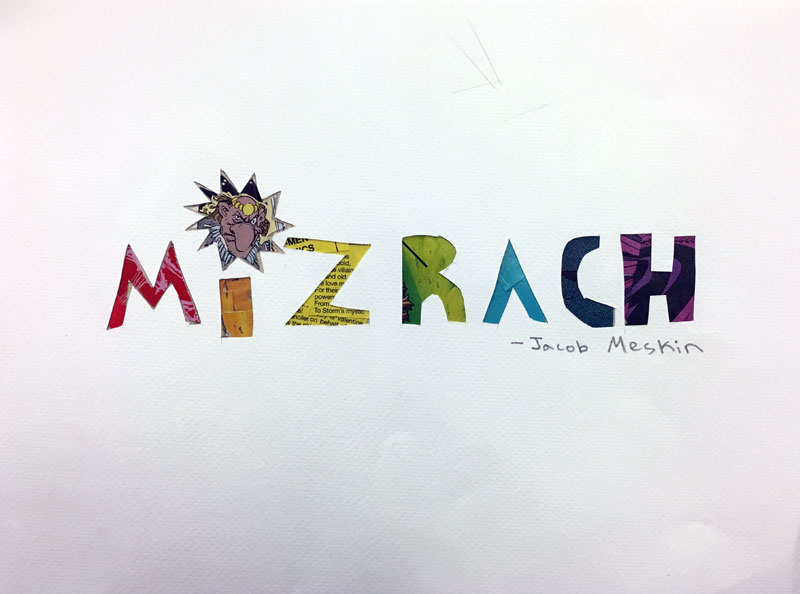
So, back to the surprise. Once the campers get familiar with their knives and what they can do (including some basic safety lessons because KNIVES), our first project is a mizrach: an ornamental wall plaque used to indicate the direction of prayer (east) in Jewish homes. We brainstormed as a group to get some ideas going, but each student designed their own mizrach and then backed it with comics.
Even though all of the campers start with the same project and the same batch of ideas, each of the pieces is incredible and unique. But this summer I was surprised that a couple of campers chose to go in a completely new direction: they went political. It was wonderful to see these teenagers working to find their voices and express themselves, especially in pursuit of a better world; see for yourself.
The artist of the mizrach above wrote, "This piece depicts a sun rising over a mountain. The theme of the piece is 'east,' or the direction you face when you pray. There is a story that states if you look directly at the sun, you are looking at God; it’s up to us whether we believe it. That is why there is an eye in the center of the sun. The meaning of 'To Be Continued' is up for you to decide, but to me it means that no matter what happens, we will continue through fighting, war, anger, and fire."
The artist of the mizrach above wrote, "This piece is about conflict between Israel and America. This is shown by putting a split between both of the flags — but both sides have their heroes. Israel has Ragman, a Jewish superhero from the DC universe. America quite obviously has Captain America. The Nazi flag is to represent neo-Nazis, and the other conflicts are just to represent war."
The second project is our BIG project: paper midrash. Each camper had to find a Jewish story or character or theme from our tradition which they wanted to explore and develop with the aid of knife and paper. Some found midrash or stories to explore in Sefer HaAggadah, others made up their own commentaries, and all of them created stunning work; there are some incredible pieces of comics in the backgrounds, often driving a lot of additional meaning.
Here they are, along with the descriptions written by the artists themselves.
All of this work will be on display as part of the annual Hagigah Peachy Levy Arts Festival at the end of their session.
The best part of this is that I don’t just do this for two weeks every summer — my wife (Rabbi Shawna Brynjegard-Bialik) and I get to bring this to different communities across the country all year, leading art workshops and talking about art and comics and Judaism; we call it Paper Midrash. If you're interested in finding out what we can do with YOUR community — for a few hours or a few days — please visit our website at www.papermidrash.com.
But let me back up a bit first, in case you’re new to this blog.
![]() |
| Same camp, new location! |
My wife and I volunteer as faculty at Camp Newman every summer for two weeks — me as an artist, and she as a rabbi. This year we were at new (temporary) location — Cal Maritime University — but camp is camp no matter where we find ourselves. I spend two hours a day, nearly every day, for two weeks, cutting paper with about 20 campers and making "paper midrash.” The work that these campers produce always sends me back to my studio full of inspiration and ready to get back to cutting paper. (My wife and I had a couple of other exciting projects this summer as well, including protest art and tallit-making; stay tuned to this blog for posts about all that stuff.)
The campers I work with are part of Hagigah, the arts track for 10th and 11th graders; these campers spend four weeks in total at Camp Newman, where they're exposed to many different forms of art, and encouraged to try them all out and learn new ways to express themselves. Among the other offerings this summer were mosaics, performance art, dance, songleading, screenprinting and Hebrew lettering.
So, back to the surprise. Once the campers get familiar with their knives and what they can do (including some basic safety lessons because KNIVES), our first project is a mizrach: an ornamental wall plaque used to indicate the direction of prayer (east) in Jewish homes. We brainstormed as a group to get some ideas going, but each student designed their own mizrach and then backed it with comics.
Even though all of the campers start with the same project and the same batch of ideas, each of the pieces is incredible and unique. But this summer I was surprised that a couple of campers chose to go in a completely new direction: they went political. It was wonderful to see these teenagers working to find their voices and express themselves, especially in pursuit of a better world; see for yourself.
| Jerusalem skyline |
| "East" in four languages |
| Sunrise over the Western Wall |
| The Old City of Jerusalem |
| The Wall, filled with notes of praise and prayer |
| The words in the figure at the bottom read, "To Be Continued." |
The artist of the mizrach above wrote, "This piece depicts a sun rising over a mountain. The theme of the piece is 'east,' or the direction you face when you pray. There is a story that states if you look directly at the sun, you are looking at God; it’s up to us whether we believe it. That is why there is an eye in the center of the sun. The meaning of 'To Be Continued' is up for you to decide, but to me it means that no matter what happens, we will continue through fighting, war, anger, and fire."
| Conflict and connection |
The artist of the mizrach above wrote, "This piece is about conflict between Israel and America. This is shown by putting a split between both of the flags — but both sides have their heroes. Israel has Ragman, a Jewish superhero from the DC universe. America quite obviously has Captain America. The Nazi flag is to represent neo-Nazis, and the other conflicts are just to represent war."
| A typographical approach |
![]() |
| Star, mountain, earth |
| A compass pointing east |
| Sun and water |
| Jewish heroes make up the wall; American symbols make up the visiting figure |
| The state of Israel |
The second project is our BIG project: paper midrash. Each camper had to find a Jewish story or character or theme from our tradition which they wanted to explore and develop with the aid of knife and paper. Some found midrash or stories to explore in Sefer HaAggadah, others made up their own commentaries, and all of them created stunning work; there are some incredible pieces of comics in the backgrounds, often driving a lot of additional meaning.
Here they are, along with the descriptions written by the artists themselves.
| "This is Moses parting the Red Sea. I made his face blank because I want people to focus on the waves and not about the way Moses looks." |
| "My piece is about Abraham and Sarah being visited by an angel to bless them with a baby." |
| The Sacrifice of Isaac |
| "This piece shows Magneto, a Holocaust survivor, crushing a swastika buried in the ground." |
| "My piece is about Ephraim’s sons. The midrash says that his children will be archers, which is with there is a bow and arrows." |
| A cairn |
| An hourglass |
All of this work will be on display as part of the annual Hagigah Peachy Levy Arts Festival at the end of their session.
The best part of this is that I don’t just do this for two weeks every summer — my wife (Rabbi Shawna Brynjegard-Bialik) and I get to bring this to different communities across the country all year, leading art workshops and talking about art and comics and Judaism; we call it Paper Midrash. If you're interested in finding out what we can do with YOUR community — for a few hours or a few days — please visit our website at www.papermidrash.com.
Labels:
Camp Newman,
comics,
Jerusalem,
mizrach,
Paper Midrash,
papercut,
workshop
Subscribe to:
Posts (Atom)