I love papercutting – and I love teaching others to cut paper, leading them to try something new and engage with our tradition in a manner very different from their usual methods. That's why I lead papercutting workshops throughout the year — and why I spend two weeks every summer at
URJ Camp Newman doing so with high school-age campers. This summer was my TENTH YEAR at Newman, and a spectacular one.
The Hagigah program at URJ Camp Newman is the premier Jewish arts teen program on the West Coast. Campers choose majors and minors in visual and performing arts, studying with distinguished Jewish artists in an exploratory and collaborative atmosphere.
Their experience culminates in the camp-wide “Mark & Peachy Levy Hagigah Festival of the Arts” to celebrate their work – and the 2016 festival is tomorrow night, July 14. This year, with thanks to Dream Lab and generous support from The
Covenant Foundation, I produced a booklet featuring all of the campers'
work — to be distributed at the festival to all attendees.
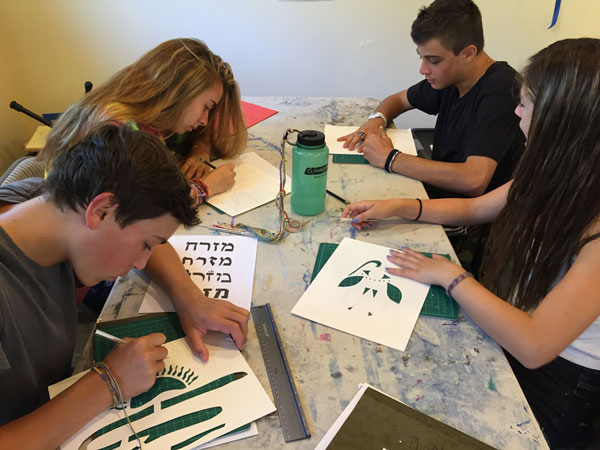
This summer I had 16 campers in my papercutting workshop – two hours every day for two weeks. The campers made some wonderful art, and I'm pleased to share it with you here.
First, the "mizrach" project. Each of the 16 campers made a
mizrach (מזרח means "east"). East is the direction that Jews outside of Israel traditionally face during prayer, and a
mizrach is an ornamental wall plaque
used to indicate the direction of prayer – and that's
what the students made, after some group brainstorming about what
imagery might work in such an artwork. They were allowed to interpret the idea of a
mizrach however they wanted. What I find fascinating about the process is how everyone starts in the same place, with the same goal... but each piece is different, expressing something about the camper-artist who made them.
 |
| Dani |
 |
| Ethan C. |
 |
| Ethan R. |
 |
| Hannah |
 |
| Hannah S. |
 |
| Jacob |
 |
| Max |
 |
| Mia |
 |
| Noah |
 |
| Phoebe |
 |
| Rachel |
 |
| Sam |
 |
| Thea |
 |
| Tristan |
 |
| Yaron |
The second project we do is "paper midrash" – each camper had to identify a story or character from Jewish tradition, and explore and develop it with the aid of knife and paper. Some worked with one of the camp rabbis to find fascinating little tidbits, others made up their own commentaries, and all of them created stunning work. I've included their descriptions of their work in the captions of the photos – their words about their inspiration and process.
 |
| Dani: "I wanted a piece that illustrated the forbiddenness of secular music in biblical times. The colours I used are meant to symbolise the beauty that music — religious or not — can bring to the world." |
 |
| Ethan C.: "I chose the story of the burning bush because I thought that it was interesting that ‘the bush burned with fire, and the bush was not consumed’ [Exodus 3:2]." |
 |
| Ethan R.: "Judah ben Tema said, ‘Be fierce as a leopard, light as an eagle, swift as a gazelle, and strong as a lion to do the will of our Father in heaven’ [Mishnah Avot 5:20]." |
 |
| Hannah: "I designed a mezuzah that has the Tree of Life in it. At the base is a pomegranate, which represents mitzvot. The tree then branches out with a Star of David, which represents Judaism. The mezuzah is being hung over the city of Jerusalem to remind us that Jerusalem is always our home." |
 |
Hannah S.: "My midrash is a depiction of the creation of night and day [Bereshit 1:4].
I like the idea of the sun and moon because they are everyday things we see, but don’t fully understand." |
 |
| Max: "This piece is a representation of the idea that everyday is a new opportunity to improve your life. Your future is constantly changing and each day is a new chance to change who you are or what you will become. Each ray of light of the sun is a different shade and design of red, yellow, orange, or purple. This is a symbol for how each day is different. It’s up to you whether or not the day is good." |
 |
| Mia: "This is my representation of Eve. She is surrounded by green to show her in the Garden. She is holding a pear instead of an apple, showing that she is good and not evil, as she is often portrayed to be. Pears represent motherhood and love. Eve stands alone in this piece because she is usually shown as simply being Adam’s partner, but this shows that she does not necessarily need a man to complete her." |
 |
| Noah: "I was interested in how Judaism teaches about death and mourning. I thought it was interesting that Jews were virtually the only ancient people to forbid cremation. As Jews, we don’t let ourselves forget the dead. This is why I wrote ‘Never Forget’ and ‘zichronam livracha’ which means ‘Let Their Memory Be For a Blessing.’ We also recognize that life is ending like a flame. This is why I chose to put darkness in place of the flame, while the candle still stands like the body we refuse to cremate." |
 |
| Peyton: "I chose to do my midrash on an olive branch and dove. When I was trying to figure out what I should do my piece on I read about how olive branches signify peace, and in the Noah’s Ark story — when the flood is over —a dove brings Noah an olive brach signifying peace and that the flood is over and a new life is waiting [Bereshit 8:11]. I love the story and I think peace is a great thing and I wanted to show that in my art." |
 |
| Phoebe: "The Babylonia Talumd tells us, ‘When a boy was born, it was custom to plant a cedar tree; and when a girl was born, an acacia. When they wed, the tree [planted at birth] was cut down and the wedding canopy made from its branches.’ I believe this tradition is so beautiful. The idea that two separate trees are planted and then brought together is so amazing, and what love should be about: two people coming together. I decided to depict an acacia and cedar branch, both with different coloring. I put a heart in between as a symbol of love, and backed it with a comic in which two people in love were holding hands." |
 |
| Sam: "As a kid, I always loved the song, ‘There’s a Dinosaur Knocking at My Door, [and He Wants to Have Shabbat with Me]’ and every time I think of that song, I get nostalgic." |
 |
| Thea: "I chose the creation/separation of night and day for my midrash [Bereshit 1:4]. I chose this theme because I think the sun and moon are very pretty. By using this story, I could incorporate the sun and moon into my art." |
 |
| Tristan: "I decided to create my piece on lightning, because it has always fascinated me. R. Berekhiah the Priest said: ‘Lightning is something generated by the fire from on high. Hence, when it goes forth, its light illuminates the world from end to end.’" |
 |
| Yaron built an ark to house the Torah – an original design, backed with super hero comics. |
I'm so proud of these campers – they created such beautiful, meaningful work.
Yasher koach to all of them!




 Posts
Posts


