Showing posts with label Talmud. Show all posts

Sunday, November 29, 2020

Arella Whirls – Commission at Sinai


"Arella Whirls" is a papercut commission made for Stephanie Swedlove to mark her conversion to Judaism, the culmination of a ten-year journey.

Torah and Talmud tell us that all Jews were at Sinai at Revelation, to accept the Torah and the covenant with God. All Jewish souls, into the future, today and tomorrow, by birth and by choice, and so on (Talmud Shevuot 39a and Shemot Rabbah 28:6). This papercut is built around Stephanie’s presence at Sinai, even as she now takes the final steps in the conversion process. Judaism also teaches us that all humanity deserves respect and justice, reinforced for us when we were slaves in Egypt, a story which we retell every year at Passover (and continually throughout our lives). This is connected to Stephanie’s drive for justice, trust, and community. This half of her story is represented with our people’s redemption, shown in the parting of the Sea of Reeds, with a path leading to Sinai.

The foundation is made of the purple costume worn by super hero Stephanie Brown, known as Spoiler – it’s where the journey starts. Up through the parted waters, which feature Arrowverse heroes (such as Felicity from Arrow, representing Stephanie’s analytic mind). “Tomorrow” references the teaching that all Jewish souls, past and present, are “right here.” Beyond/above the waves are verses from Devarim/Deuteronomy 29: 9-14, in which we read about all the people and future generations standing at Sinai in acceptance of the covenant.

In front of Mount Sinai we have the Teen Titans, with the voice of the Divine echoing around them. The lightning of God’s voice (based on a Hebrew pun in Shemot/Exodus 20:15) is made of another hero from the Arrowverse, the Flash, and in the clouds that swirl around the mountain like the smoke from a kiln (Shemot/Exodus 19:18) comic captions read “Arella Whirls” and “Arella Turns,” reflecting the joyous dancing of the Israelites after the crossing of the Sea and in acceptance of the Torah. And of course, Arella is Stephanie’s chosen Hebrew name – reflected as well in the shape of Mt. Sinai, an abstract aleph.

Comics in the papercut include:
  • Batgirl Annual #3 (January 2015)
  • Batman: Huntress/Spoiler #1 (May 1998)
  • Blackest Night: The Flash #1 (February 2010)
  • Gotham Underground #2 (January 2008)
  • Justice League of America #46 (August 2010)
  • Shazam: Power of Hope (November 2000)
  • The New Teen Titans #2 (October 1984), #4 (January 1985)
  • Teen Titans #6 (May 2017)

Sunday, March 22, 2020

How Can We Serve God with the Works of Our Hands?

[This post originally appeared on ReformJudaism.org]

This week, as we begin the Book of Leviticus with Parashat Vayikra, we read about the eternal flame in the Temple in Jerusalem — a symbol of God’s Presence amidst the Jewish people. The smoke rising from the altar was a remnant of our communications with God — physical evidence that we had engaged with the Eternal.
Cantor David Berger writes that “As moderns we have fully embraced the transition from Temple service to ‘the service of the heart,’” citing Babylonian Talmud, Taanit 2a:
To love the Lord your God and to serve Him with all your heart” (Deut. 11:13). Which is the service of God that is performed in the heart? You must say that this is referring to prayer.
We could take this to mean that as we no longer make physical sacrifices, rather than serving God with our hands, we serve with our hearts and minds. And yes, we have transformed Judaism — the work of our hands, turning substance into flame and smoke became the work of our minds, turning words into music and praise. But where does that leave our hands? I suggest that we still have the power — and the responsibility — to serve God with our hands.

The altar smoke — “of pleasing odor to the Eternal” (Lev. 2:9) — is akin to a finished work of art created by a painter or sculptor. It is the lingering echo of music after an orchestra plays or the warmth of a room that has been filled with dancers exercising their bodies. A painting is the evidence that we have painted — and art about the Jewish experience is evidence of our efforts to commune with our people across time, and with the Divine.

The Jewish-American artist Barbara Kruger said, “Making art is about objectifying your experience of the world, transforming the flow of moments into something visual, or textual, or musical, whatever.” When we use the work of our hands in concert with the work of our minds, we can transform our personal experience of the world and the Divine into a shared moment — into a part of the continuing conversation that has been part and parcel of Judaism since the Divine creation of the world.

Our history reveals a continuous connection between art and Jewish practice — from the carving of the Ten Commandments in the moments before the first Shabbat at the end of Creation (Pirkei Avot 5:6) to Bezalel leading the Israelites in the building of the desert Mishkan (Ex. 35), to the commandment of hiddur mitzvah, “beautifying the commandments.” In Midrash M’chilta d’ Rabbi Ishmael,it says:
“I shall glorify God in the way I perform mitzvot. I shall prepare a beautiful lulav, beautiful sukkah, beautiful tzitzit, and beautiful tefillin.” (Shirata, Ch. 3). The Talmud adds, “a beautiful shofar and a beautiful Torah scroll which has been written by a skilled scribe with fine ink and fine pen and wrapped in beautiful silks” (Shabbat 133b).
Our hands still can — and must — do the work of connecting us to the Divine. We can paint, draw, weave, cut, carve, and inscribe — in the service of our people and the Eternal. We can tell our story, praise God, and promote the ideals of tzedakah, emet and shalom.

"Altar Flame" and "Altar Smoke"
[click to enlarge]
 In my work as a papercutter I am in constant engagement with this task, cutting up and collaging comic books and other found materials and using them as a lens through which to study Torah and make “paper midrash.” My papercuts “Altar Flame” and “Altar Smoke” are two explorations of this week’s parashah: attempts to find meaning in superseded ritual practices.

Both of these papercuts reflect the connection between the Jewish people and the Divine, in ancient and modern practice. Within the flames rising from the altar can be found Phoenix, a superhero member of the X-Men with godlike powers, as well as Wonder Woman, whose story is one of constant back-and-forth between gods and human beings. Tucked into the sacrificial smoke are comics featuring godlike heroes like Superman and Thor and also very human heroes like Batman. Our narratives about the relationships of these super-powered beings, and how they connect with the people around them, an inform our ideas about our relationship with God. We ask ourselves what it means to communicate directly with the Divine, and for what purpose we praise God with our hands and hearts.

Jews have always made things of beauty — for ritual and observance, and also to inspire people and praise the Divine. The work of our hands is vital to the work of our souls.

Wednesday, August 2, 2017

"Extreme Mosaic-ing" at Camp Newman for 70th Anniversary Celebration

"Create connections and study Torah, because Torah is acquired through friendship." What fine words to sum up the experience of Jewish summer camp – a place where we live Jewishly, where we make new friends, and gain knowledge (and have fun) together. They are the words at the top of the new mosaic we made at camp this summer at the 70th Anniversary Celebration of West Coast Jewish Summer Camp, held at URJ Camp Newman in July.

The original logo as used in promotional materials.

Sunday, July 16, hundreds of people convened in Santa Rosa at Camp Newman to celebrate 70 years of west coast Jewish camping – from Camp Saratoga to Camp Swig to Camp Newman. It was an unforgettable day at our home away from home, with singing and dancing and reconnecting... and one more big thing: making a 24-square-foot mosaic in just four hours!


My wife (Rabbi Shawna Brynjegard-Bialik) and I were asked by camp to lead an community art project: making a new mosaic for Camp Newman that would commemorate the 70th celebration, and getting the hundreds of celebrants joining us at camp to all put a piece (or two or three) in. And we did it!


I designed the original logo for the celebration, and we designed the mosaic to build that logo into a full camp landscape – along with input and support from camp artists from over the decades.

Rabbi Shawna with the incredible and indefatigable Charles Yoakum and Max Winer!

We spent most of the morning before everyone arrived at camp getting it all set up, and then over the course of four hours we worked as hard and as quickly as ever we have on any mosaic, which is why we took to calling it "extreme mosaic-ing."


We were pleased to welcome Rabbi Rick Jacobs, president of the Union for Reform Judaism, who joined us to place a few pieces in the mosaic as well.


And the mosaic was complete before the end of the celebration! Here's a mock-up we made in Photoshop; we promise to share photos of it in its  camp home as soon as its up.

The final mosaic!

Big thanks to Heath Ceramics and Tile Clearance, Inc., who both contributed tile to the camp so we could get this done.

Want information on how you can bring me and Rabbi Shawna to YOUR community? Check out our new website: www.PaperMidrash.com.

Thursday, January 5, 2017

Learning and teaching at Limmud in England

Heavy coats at all times for winter in Birmingham – below freezing most mornings!

Limmud UK! Thousands of attendees from around the world, hundreds of sessions — all focused on Jewish culture, education, and art. This is the 20th year of the conference… but our first.

Six months ago when my wife and I were first approached to teach at the conference in Birmingham, England, we were a little unsure about what it would be like, but we decided to take the leap — and it was fantastic!


Wearing the colors.


My wife, Rabbi Shawna Brynjegard-Bialik, and I were asked to lead as many sessions at the week-long conference as wanted, so we picked some of our favorite topics and put together a host of options combining my art and her scholarship, some of which we’d presented elsewhere but some of which were completely new:

  • Women of Valor and Other Super Heroes
  • Damaged Heroes: Midrash and Pop Culture Mythology
  • Under the Chuppah with Superman and Lois Lane
  • Paper Midrash: Text Study with Knives


We'll be doing all this again in Fresno this spring, in case you missed us in England.

Most of these sessions centered around conversations between me and Shawna, with slides and text handouts for everyone in the session. It was great to share our ideas with inquisitive and engaged people. The “text study with knives” workshop almost didn’t happen… funny story: I had asked for art knives and cutting matts to be provided, and the resources folks were happy to introduce themselves to me with a box containing… BUTCHER KNIVES AND FOOD PREP CUTTING BOARDS. Split between anxiety and laughter, it wasn’t long before the confusion was resolved and the proper materials were located. I would be remiss if I didn't mention at this juncture how incredible the all-volunteer conference staff was in every way — as I said, THOUSANDS of attendees and HUNDREDS of sessions, and it all ran so smoothly... yashar koach to Limmud!

Plenty of photos from the workshop, since my kids were there (and willing).


I was also a panelist in a session on “Pictures That Say 1000 Words” (I discussed Morris Louis’s “Pillar of Delay”) and Shawna read a letter in the first “Limmud Letters Live” session (she read Henrietta Szold’s letter on saying kaddish).

But of course, there were so many hours in the day and SO MANY SESSIONS to attend, so we took advantage of all that Limmud had to offer. Torah, Talmud, Israel, cherry tomatoes (seriously)… and of course, I attended all of the art sessions I could fit into my schedule.


One of several GREAT sessions led by Professor Marc Michael Epstein of Vassar College

Artist Jacqueline Nicholls was also one of my favorite presenters; here she is discussing her "Draw Yomi / Daf Yom" project.

And here's Jacqueline Nicholls presenting a panel from "V for Vendetta" as part of the "Protest Art" panel.

I went to a session on the New Venice Hagaddah, which includes work by my buddy Hillel Smith.


The conference took place over Hanukkah, and with our kids by our side (whom we’d brought along and who also enjoyed the heck out of Limmud) we participated in the nightly candle-lighting (big group lightings and individual hanukkiah lightings as well).


And of course, lots of socializing (I met and hung out with the incomparable Jeff Klepper!), Pokemon with "Rashi's Daughters" and "Fifty Shades of Talmud" author Maggie Anton (not joking), and Snapchatting.


I hope we have the chance to attend again — to learn and teach with our extended global Jewish community, and to revel in our religion and culture and traditions.


Wednesday, July 13, 2016

Teenagers + knives = magic


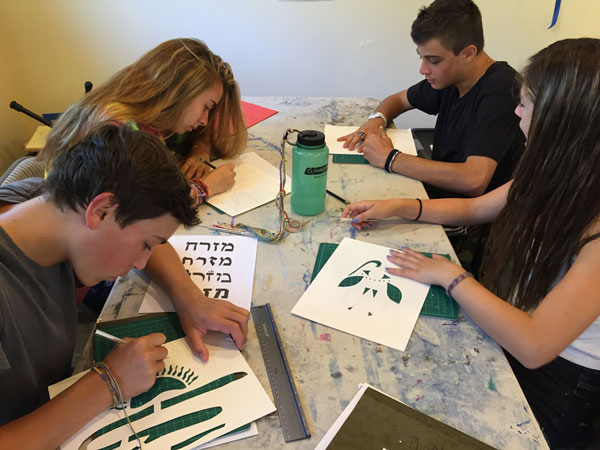
I love papercutting – and I love teaching others to cut paper, leading them to try something new and engage with our tradition in a manner very different from their usual methods. That's why I lead papercutting workshops throughout the year — and why I spend two weeks every summer at URJ Camp Newman doing so with high school-age campers. This summer was my TENTH YEAR at Newman, and a spectacular one.


The Hagigah program at URJ Camp Newman is the premier Jewish arts teen program on the West Coast. Campers choose majors and minors in visual and performing arts, studying with distinguished Jewish artists in an exploratory and collaborative atmosphere.


Their experience culminates in the camp-wide “Mark & Peachy Levy Hagigah Festival of the Arts” to celebrate their work – and the 2016 festival is tomorrow night, July 14. This year, with thanks to Dream Lab and generous support from The Covenant Foundation, I produced a booklet featuring all of the campers' work — to be distributed at the festival to all attendees.


This summer I had 16 campers in my papercutting workshop – two hours every day for two weeks. The campers made some wonderful art, and I'm pleased to share it with you here.


First, the "mizrach" project. Each of the 16 campers made a mizrach (מזרח means "east"). East is the direction that Jews outside of Israel traditionally face during prayer, and a mizrach is an ornamental wall plaque used to indicate the direction of prayer – and that's what the students made, after some group brainstorming about what imagery might work in such an artwork. They were allowed to interpret the idea of a mizrach however they wanted. What I find fascinating about the process is how everyone starts in the same place, with the same goal... but each piece is different, expressing something about the camper-artist who made them.

Dani

Ethan C.

Ethan R.

Hannah

Hannah S.

Jacob

Max

Mia

Noah

Phoebe

Rachel

Sam

Thea

Tristan

Yaron

The second project we do is "paper midrash" – each camper had to identify a story or character from Jewish tradition, and explore and develop it with the aid of knife and paper. Some worked with one of the camp rabbis to find fascinating little tidbits, others made up their own commentaries, and all of them created stunning work. I've included their descriptions of their work in the captions of the photos – their words about their inspiration and process.

Dani: "I wanted a piece that illustrated the forbiddenness of secular music in biblical times. The colours I used are meant to symbolise the beauty that music — religious or not — can bring to the world."

Ethan C.: "I chose the story of the burning bush because I thought that it was interesting that ‘the bush burned with fire, and the bush was not consumed’ [Exodus 3:2]."

Ethan R.: "Judah ben Tema said, ‘Be fierce as a leopard, light as an eagle, swift as a gazelle, and strong as a lion to do the will of our Father in heaven’ [Mishnah Avot 5:20]."

Hannah: "I designed a mezuzah that has the Tree of Life in it. At the base is a pomegranate, which represents mitzvot. The tree then branches out with a Star of David, which represents Judaism. The mezuzah is being hung over the city of Jerusalem to remind us that Jerusalem is always our home."

Hannah S.: "My midrash is a depiction of the creation of night and day [Bereshit 1:4].
I like the idea of the sun and moon because they are everyday things we see, but don’t fully understand."

Max: "This piece is a representation of the idea that everyday is a new opportunity to improve your life. Your future is constantly changing and each day is a new chance to change who you are or what you will become. Each ray of light of the sun is a different shade and design of red, yellow, orange, or purple. This is a symbol for how each day is different. It’s up to you whether or not the day is good."

Mia: "This is my representation of Eve. She is surrounded by green to show her in the Garden. She is holding a pear instead of an apple, showing that she is good and not evil, as she is often portrayed to be. Pears represent motherhood and love. Eve stands alone in this piece because she is usually shown as simply being Adam’s partner, but this shows that she does not necessarily need a man to complete her."

Noah: "I was interested in how Judaism teaches about death and mourning. I thought it was interesting that Jews were virtually the only ancient people to forbid cremation. As Jews, we don’t let ourselves forget the dead. This is why I wrote ‘Never Forget’ and ‘zichronam livracha’ which means ‘Let Their Memory Be For a Blessing.’ We also recognize that life is ending like a flame. This is why I chose to put darkness in place of the flame, while the candle still stands like the body we refuse to cremate."

Peyton: "I chose to do my midrash on an olive branch and dove. When I was trying to figure out what I should do my piece on I read about how olive branches signify peace, and in the Noah’s Ark story — when the flood is over —a dove brings Noah an olive brach signifying peace and that the flood is over and a new life is waiting [Bereshit 8:11]. I love the story and I think peace is a great thing and I wanted to show that in my art."

Phoebe: "The Babylonia Talumd tells us, ‘When a boy was born, it was custom to plant a cedar tree; and when a girl was born, an acacia. When they wed, the tree [planted at birth] was cut down and the wedding canopy made from its branches.’ I believe this tradition is so beautiful. The idea that two separate trees are planted and then brought together is so amazing, and what love should be about: two people coming together. I decided to depict an acacia and cedar branch, both with different coloring. I put a heart in between as a symbol of love, and backed it with a comic in which two people in love were holding hands."

Sam: "As a kid, I always loved the song, ‘There’s a Dinosaur Knocking at My Door, [and He Wants to Have Shabbat with Me]’ and every time I think of that song, I get nostalgic."

Thea: "I chose the creation/separation of night and day for my midrash [Bereshit 1:4]. I chose this theme because I think the sun and moon are very pretty. By using this story, I could incorporate the sun and moon into my art."

Tristan: "I decided to create my piece on lightning, because it has always fascinated me. R. Berekhiah the Priest said: ‘Lightning is something generated by the fire from on high. Hence, when it goes forth, its light illuminates the world from end to end.’"

Yaron built an ark to house the Torah – an original design, backed with super hero comics.


I'm so proud of these campers – they created such beautiful, meaningful work. Yasher koach to all of them!