Showing posts with label URJ. Show all posts

Sunday, March 22, 2020

How Can We Serve God with the Works of Our Hands?

[This post originally appeared on ReformJudaism.org]

This week, as we begin the Book of Leviticus with Parashat Vayikra, we read about the eternal flame in the Temple in Jerusalem — a symbol of God’s Presence amidst the Jewish people. The smoke rising from the altar was a remnant of our communications with God — physical evidence that we had engaged with the Eternal.
Cantor David Berger writes that “As moderns we have fully embraced the transition from Temple service to ‘the service of the heart,’” citing Babylonian Talmud, Taanit 2a:
To love the Lord your God and to serve Him with all your heart” (Deut. 11:13). Which is the service of God that is performed in the heart? You must say that this is referring to prayer.
We could take this to mean that as we no longer make physical sacrifices, rather than serving God with our hands, we serve with our hearts and minds. And yes, we have transformed Judaism — the work of our hands, turning substance into flame and smoke became the work of our minds, turning words into music and praise. But where does that leave our hands? I suggest that we still have the power — and the responsibility — to serve God with our hands.

The altar smoke — “of pleasing odor to the Eternal” (Lev. 2:9) — is akin to a finished work of art created by a painter or sculptor. It is the lingering echo of music after an orchestra plays or the warmth of a room that has been filled with dancers exercising their bodies. A painting is the evidence that we have painted — and art about the Jewish experience is evidence of our efforts to commune with our people across time, and with the Divine.

The Jewish-American artist Barbara Kruger said, “Making art is about objectifying your experience of the world, transforming the flow of moments into something visual, or textual, or musical, whatever.” When we use the work of our hands in concert with the work of our minds, we can transform our personal experience of the world and the Divine into a shared moment — into a part of the continuing conversation that has been part and parcel of Judaism since the Divine creation of the world.

Our history reveals a continuous connection between art and Jewish practice — from the carving of the Ten Commandments in the moments before the first Shabbat at the end of Creation (Pirkei Avot 5:6) to Bezalel leading the Israelites in the building of the desert Mishkan (Ex. 35), to the commandment of hiddur mitzvah, “beautifying the commandments.” In Midrash M’chilta d’ Rabbi Ishmael,it says:
“I shall glorify God in the way I perform mitzvot. I shall prepare a beautiful lulav, beautiful sukkah, beautiful tzitzit, and beautiful tefillin.” (Shirata, Ch. 3). The Talmud adds, “a beautiful shofar and a beautiful Torah scroll which has been written by a skilled scribe with fine ink and fine pen and wrapped in beautiful silks” (Shabbat 133b).
Our hands still can — and must — do the work of connecting us to the Divine. We can paint, draw, weave, cut, carve, and inscribe — in the service of our people and the Eternal. We can tell our story, praise God, and promote the ideals of tzedakah, emet and shalom.

"Altar Flame" and "Altar Smoke"
[click to enlarge]
 In my work as a papercutter I am in constant engagement with this task, cutting up and collaging comic books and other found materials and using them as a lens through which to study Torah and make “paper midrash.” My papercuts “Altar Flame” and “Altar Smoke” are two explorations of this week’s parashah: attempts to find meaning in superseded ritual practices.

Both of these papercuts reflect the connection between the Jewish people and the Divine, in ancient and modern practice. Within the flames rising from the altar can be found Phoenix, a superhero member of the X-Men with godlike powers, as well as Wonder Woman, whose story is one of constant back-and-forth between gods and human beings. Tucked into the sacrificial smoke are comics featuring godlike heroes like Superman and Thor and also very human heroes like Batman. Our narratives about the relationships of these super-powered beings, and how they connect with the people around them, an inform our ideas about our relationship with God. We ask ourselves what it means to communicate directly with the Divine, and for what purpose we praise God with our hands and hearts.

Jews have always made things of beauty — for ritual and observance, and also to inspire people and praise the Divine. The work of our hands is vital to the work of our souls.

Wednesday, October 11, 2017

My heart is with Camp Newman.

This week we had some very sad news – our beloved Camp Newman was destroyed by wildfires... and yet, we will rebuild, somehow. We are #newmanstrong. As the camp website puts it, "Camp Newman is more than just buildings. It is a community built on the memories of 70 glorious summers." With that in mind I wanted to share a few photos from my 11 summers at Camp Newman – some of the work made by campers in my Hagigah papercutting and mosaic workshops over the years.

One of my first mural projects at Camp Newman was in 2009
with a bunch of staff kids, while we struggled with the "Swine '09" debacle.
(Yes, that's a thermometer in the pig's mouth.)

Rabbi Shawna Brynjegard-Bialik (my wife) and I working on a live painting
to accompany a story from Rabbi Paul Kipnes.

2010 camper work

A group "shin" project for workshop students in 2011,
which we gave to the camp as a gift.

Working with campers in 2012

For "Faculty Art Night" in 2012 we made papercut mezuzot for the camp.

Detail from 2012 "Faculty Art Night" mezuzah.

2013 camper work


2013 camper workshop group project: "Kehillah Kedoshah" (Holy Community)

Sometimes we'd make a little guerila stencil art for camp...

2014 "Ma Tovu" mosaic made by Hagigah campers for one of the new cabins

2015 campers hard at work in the Hagigah Building

2015 camper work

2015 camper work

In 2016 campers made a "Miriam's Well" mosaic –
and we had a faculty mosaic night to share the fun!

2016 camper work

The finished "Miriam's Well" mosaic in place around a water bottle refilling station.

2017 camper work

2017 camper work

The 2017 Hagigah campers made a "Tallit Blessing" mosaic for the new cabins

At work with campers in 2017


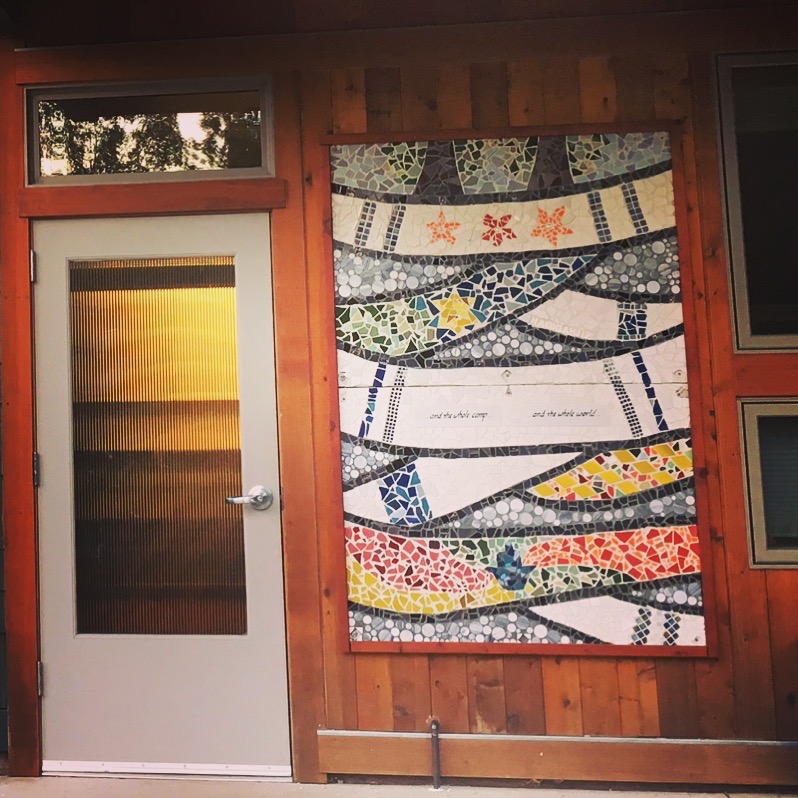
For the 2017 "70th Anniversary Celebration" we made a mosaic featuring the 70th logo.

URJ President Rabbi Rick Jacobs (center) and Rabbi Shawna B2 (right)
working together on the anniversary mosaic.

You can help rebuild Camp Newman – visit campnewman.org/support-newman/newmanstrong to contribute to #newmanstrong!

Wednesday, August 2, 2017

"Extreme Mosaic-ing" at Camp Newman for 70th Anniversary Celebration

"Create connections and study Torah, because Torah is acquired through friendship." What fine words to sum up the experience of Jewish summer camp – a place where we live Jewishly, where we make new friends, and gain knowledge (and have fun) together. They are the words at the top of the new mosaic we made at camp this summer at the 70th Anniversary Celebration of West Coast Jewish Summer Camp, held at URJ Camp Newman in July.

The original logo as used in promotional materials.

Sunday, July 16, hundreds of people convened in Santa Rosa at Camp Newman to celebrate 70 years of west coast Jewish camping – from Camp Saratoga to Camp Swig to Camp Newman. It was an unforgettable day at our home away from home, with singing and dancing and reconnecting... and one more big thing: making a 24-square-foot mosaic in just four hours!


My wife (Rabbi Shawna Brynjegard-Bialik) and I were asked by camp to lead an community art project: making a new mosaic for Camp Newman that would commemorate the 70th celebration, and getting the hundreds of celebrants joining us at camp to all put a piece (or two or three) in. And we did it!


I designed the original logo for the celebration, and we designed the mosaic to build that logo into a full camp landscape – along with input and support from camp artists from over the decades.

Rabbi Shawna with the incredible and indefatigable Charles Yoakum and Max Winer!

We spent most of the morning before everyone arrived at camp getting it all set up, and then over the course of four hours we worked as hard and as quickly as ever we have on any mosaic, which is why we took to calling it "extreme mosaic-ing."


We were pleased to welcome Rabbi Rick Jacobs, president of the Union for Reform Judaism, who joined us to place a few pieces in the mosaic as well.


And the mosaic was complete before the end of the celebration! Here's a mock-up we made in Photoshop; we promise to share photos of it in its  camp home as soon as its up.

The final mosaic!

Big thanks to Heath Ceramics and Tile Clearance, Inc., who both contributed tile to the camp so we could get this done.

Want information on how you can bring me and Rabbi Shawna to YOUR community? Check out our new website: www.PaperMidrash.com.

Tuesday, July 1, 2014

Cutting Paper at Camp Newman, 2014: Part 1

I've returned from my annual residency at URJ Camp Newman, and I had (as usual) a wonderful time – two weeks teaching papercutting to the campers in the Hagigah session, praying in the midst of giant trees, hanging out with our once-a-year faculty friends, and even trying a few new things (more on that to come).

First, however, I wanted to share some photos from my papercutting workshop. This year I had a group of 18 kids cutting with me every day (yikes!) – a very big group, but also a very talented group.


I've written in past years about Hagigah – the camp session focused on Jewish expression through the arts (fine art, dance, music, writing, photography, video, and more). They're all high school students, and many of them have been coming to Camp Newman since they were little.


First day? We get knives (after a talk on knife safety). And then we're off to the races, with two hours a day of cutting.


The first project was a mizrach, an ornamental wall plaque used to indicate the direction of prayer (east) in Jewish homes. We brainstormed as a group to get some ideas going, but each student designed their own mizrach, and then backed it with comics.


The second (big) project was to create "paper midrash" – using papercutting to tell or add to a story from the Tanakh (Torah, prophets, and writings) or midrash.  Some chose to work with stories from the b'nei mitzvah portions, or related to their names, or they just found something that interested them – it was entirely up to them (with a little guidance from me and some camp rabbis).


Both works from all campers will be shown in the annual "Peachy Levy Festival of the Arts" held at camp at the end of Hagigah. I'm holding back photos of the finished pieces until after the festival – that way the kids can premiere their work. But I *do* have pictures of the BACKS of their pieces...


Tuesday, December 17, 2013

On Being the URJ Biennial Artist-in-Residence


What an incredible experience. Five thousand Reform Jews from around the world (mostly from North America) gathering together in San Diego for the 2013 URJ Biennial, where I was the artist-in-residence.

Getting started in my mobile studio.
I had three things to get done: the first was to create an original artwork inspired by Biennial, created entirely at Biennial in the kikar (the “public square”). The second was to share my process with anyone and everyone who came by my mobile studio, and the third was to lead a workshop in papercutting and help people make their own art.

The first piece cut.
I’d never had to work in public in this way before – and it was certainly a challenge. It’s one thing to be working in the safety of my studio, where I can make decisions (and mistakes) on my own and not worry about how messy the process can be. To be exposed like I was, with people watching me sketch and cut and search and paste... it was unnerving at times, but energizing at others. The hardest part might have been finding enough time to keep working on the papercut while talking to so many people who wanted to hear about my process.

Left, the mountain begins to take shape. Right: one of the first background pieces.

As for the workshop: three dozen people joined me to express ourselves through the cutting of paper. Margaret and Lou and Shoshana and Joe and Robin and Wilma and Heidi... so many wonderful budding artists. It was both exhausting and invigorating. We had four hours together, and I am so proud of the work everyone made.

Photo from the URJ
Photo from the URJ

And somehow it happened: although Wednesday morning I had only a large blank sheet of cold-press watercolor stock, by Saturday night I had completed “Gathering.”


Wednesday I studied and sketched, Thursday I cut paper to create the top layer, Friday I disassembled and then reassembled pieces from comic books and maps and other ephemera to create the background, and Saturday after my workshop I put the last pieces together.

The idea inspiring the piece is simple, really – I came to see the Biennial as a “Sinai moment,” all of us gathered together to worship and receive Torah and study and learn.


As with all of my work, words from Torah informed the piece. In Exodus 19:18 we read, “Now Mount Sinai was all in smoke, for Adonai descended upon it in fire, and the smoke rose like the smoke of a kiln, and the whole mountain trembled violently.” That’s the way I like to think of Revelation – as a kiln. The smoke of God’s presence surrounding the top of the mountain reminds us that we are not just gathering, but creating. We came together to discuss strengthening our movement and building a vibrant and relevant Jewish future.


The mountain itself is built out of the honeycomb iconography of the Biennial, with the riot of colors and textures underneath reflecting the content of the sessions, the sanctity of our prayers, and the specific geography of Biennial. The space surrounding the mountain is made of cut-up books and ephemera, including a dictionary and an encyclopedia, with references to Sinai, San Diego, Torah, music, prayer and the Reform movement.

The completed papercut: "Gathering"
I am grateful to have been given the opportunity to serve as Biennial artist-in-residence; it was a pleasure and a privilege to study and teach and learn and create with this community.

“Gathering” includes these comics (and more) in the background:
  • Action Comics #25 (Jan 2014)
  • Animal Man #2 (Dec 2001)
  • Batman: The Black Glove (2008)
  • Captain Atom #3 (Jan 2012)
  • The Flash: Rebirth #1 (June 2009)
  • Green Arrow #22 (May 2003)
  • Green Arrow and Black Canary #8 (Jul 2008)
  • Green Lantern: Fear Itself #1 (2011)
  • Infinite Vacation #5 (Jan 2013)
  • Invincible Iron Man #25 (Aug 2010)
  • Justice League #1 (Oct 2011)
  • Metamorpho and Aquaman #1 (Oct 2007)
  • Supergirl and the Legion of Super-Heroes #25 (Feb 2007)
  • Testament #3 (Apr 2006)
  • Wonder Woman #10 (Aug 2007)

“Gathering” also includes pieces of the following:
  • The Future of Judaism in America, by Eugene Kohn. (The Liberal Press, New York, 1934.)
  • Union Hymnal, Third Edition. The Central Conference of American Rabbis, New York, 1958).
  • Pathways Through the Bible, by Mortimer J. Cohen. (The Jewish Publication Society of America, New York, 1966).

The final work will hang in the URJ’s New York offices, and for a limited time we are making archival giclée prints available to anyone interested in having a reminder of Biennial for themselves. The prints measure 16” x 20” and will be mailed in an artwork tube; the price is $120.00 (including domestic shipping), and the proceeds are being split with the Union for Reform Judaism. To order, please visit my online store.