I’ve been cutting paper with campers at
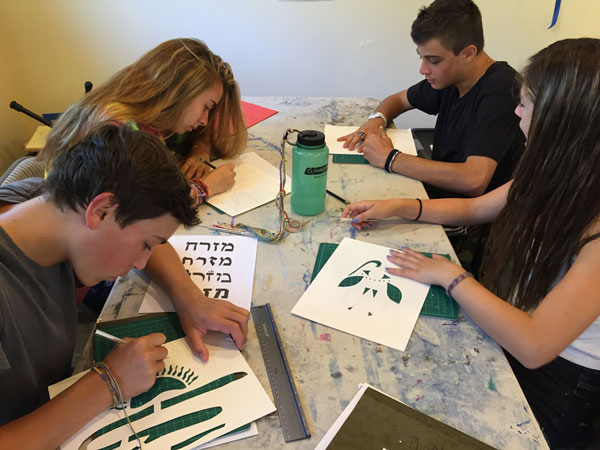
URJ Camp Newman for twelve years, and every year it’s roughly the same. I’ve got a lesson plan, and we do the same sorts of projects; I’ve got a pretty solid system in place. Which is why I was so surprised to be surprised this summer, as a couple of campers did something I’ve never seen before.
But let me back up a bit first, in case you’re new to this blog.
 |
| Same camp, new location! |
My wife and I volunteer as faculty at Camp Newman every summer for two weeks — me as an artist, and she as a rabbi. This year we were at new (temporary) location — Cal Maritime University — but camp is camp no matter where we find ourselves. I spend two hours a day, nearly every day, for two weeks, cutting paper with about 20 campers and making "paper midrash.” The work that these campers produce always sends me back to my studio full of inspiration and ready to get back to cutting paper. (My wife and I had a couple of other exciting projects this summer as well, including protest art and tallit-making; stay tuned to this blog for posts about all that stuff.)
The campers I work with are part of Hagigah, the arts track for 10th and 11th graders; these campers spend four weeks in total at Camp Newman, where they're exposed to many different forms of art, and encouraged to try them all out and learn new ways to express themselves. Among the other offerings this summer were mosaics, performance art, dance, songleading, screenprinting and Hebrew lettering.
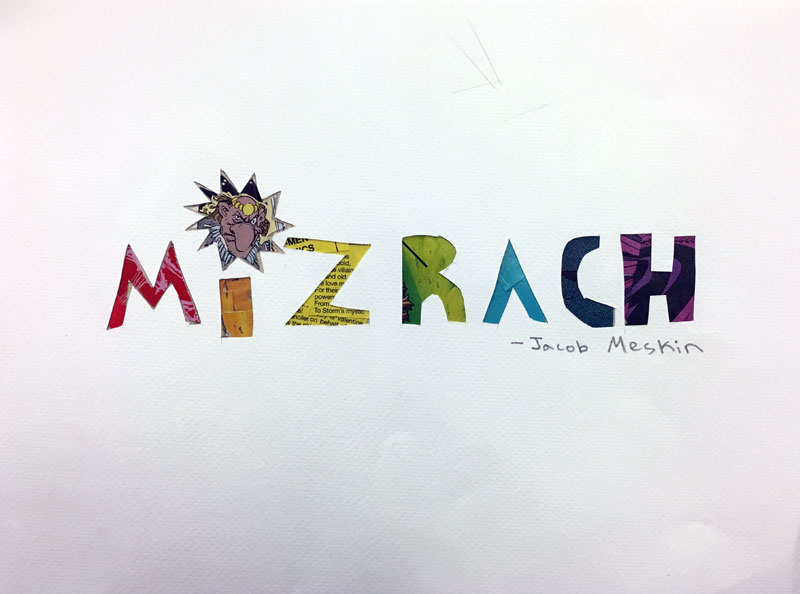
So, back to the surprise. Once the campers get familiar with their knives and what they can do (including some basic safety lessons because KNIVES), our first project is a mizrach: an ornamental wall plaque used to indicate the direction of prayer (east) in Jewish homes. We brainstormed as a group to get some ideas going, but each student designed their own mizrach and then backed it with comics.
Even though all of the campers start with the same project and the same batch of ideas, each of the pieces is incredible and unique. But this summer I was surprised that a couple of campers chose to go in a completely new direction: they went political. It was wonderful to see these teenagers working to find their voices and express themselves, especially in pursuit of a better world; see for yourself.
 |
| Jerusalem skyline |
 |
| "East" in four languages |
 |
| Sunrise over the Western Wall |
 |
| The Old City of Jerusalem |
 |
| The Wall, filled with notes of praise and prayer |
 |
| The words in the figure at the bottom read, "To Be Continued." |
|
The artist of the
mizrach above wrote, "This piece depicts a sun rising over a mountain. The theme of the piece is 'east,' or the direction you face when you pray. There is a story that states if you look directly at the sun, you are looking at God; it’s up to us whether we believe it. That is why there is an eye in the center of the sun. The meaning of 'To Be Continued' is up for you to decide, but to me it means that no matter what happens, we will continue through fighting, war, anger, and fire."
 |
| Conflict and connection |
The artist of the
mizrach above wrote, "This piece is about conflict between Israel and America. This is shown by putting a split between both of the flags — but both sides have their heroes. Israel has Ragman, a Jewish superhero from the DC universe. America quite obviously has Captain America. The Nazi flag is to represent neo-Nazis, and the other conflicts are just to represent war."
 |
| A typographical approach |
 |
| Star, mountain, earth |
 |
| A compass pointing east |
 |
| Sun and water |
 |
| Jewish heroes make up the wall; American symbols make up the visiting figure |
 |
| The state of Israel |
The second project is our BIG project: paper midrash. Each camper had to find a Jewish story or character or theme from our tradition which they wanted to explore and develop with the aid of knife and paper. Some found midrash or stories to explore in
Sefer HaAggadah, others made up their own commentaries, and all of them created stunning work; there are some incredible pieces of comics in the backgrounds, often driving a lot of additional meaning.
Here they are, along with the descriptions written by the artists themselves.
 |
| "This is Moses parting the Red Sea. I made his face blank because I want people to focus on the waves and not about the way Moses looks." |
 |
| "My piece is about Abraham and Sarah being visited by an angel to bless them with a baby." |
 |
| "For my midrash, I decided to show Joseph’s dream of him ruling over his father, mother, and 11 siblings. This is shown by a crown overlooking a sun, moon, and 11 stars. I made the stars different colors to show different siblings. The crown is starry to show how majestic and powerful Joseph is. This all together shows Joseph’s dream told in midrash." |
 |
| "This piece depicts the crossing of the Red Sea. Egypt and Israel are shown on either side of the sea; the words 'Mi chamocha ba’eilim Adonai' ('Who is like You among the gods, Adonai?') are written across the middle." |
 |
| "This piece of art tells the story of Jacob and Asaav in the womb when Asaav steals the role of the first-born by pulling Jacob’s ankle down and pushing himself out to be born. He does this to earn the birthright of the first-born." |
 |
| The Sacrifice of Isaac |
 |
| "This is my alternative to the midrash project that I used to help show my Jewish identity. When I had trouble finding midrash to make a piece on, I decided to make an ode to our history that is our suffering. The biggest part of our Jewish identity is that we keep coming back from devastating events and every time, survive further. The fact that I can make a piece of art 2000 years later about a devastating event to us shows that our resilience is nothing to be ignored." |
 |
| "This piece shows Magneto, a Holocaust survivor, crushing a swastika buried in the ground." |
 |
| "My piece is about Ephraim’s sons. The midrash says that his children will be archers, which is with there is a bow and arrows." |
 |
| A cairn |
 |
| "From the Torah, and the writings of many rabbis, anger and evil are seen as two separate things. Evil is a punishable impurity. Anger is different; anger is not bad – it is an emotion. Anger takes away the good and wisdom within a man. I made a figure with a mask to represent this. The mask is filled with images of angry heroes. I chose a mask with these images because it gives the idea that even a pure man can do wrong while misled in anger." |
 |
| An hourglass |
All of this work will be on display as part of the annual Hagigah Peachy Levy Arts Festival at the end of their session.
The best part of this is that I don’t just do this for two weeks every summer — my wife (Rabbi Shawna Brynjegard-Bialik) and I get to bring this to different communities across the country all year, leading art workshops and talking about art and comics and Judaism; we call it Paper Midrash. If you're interested in finding out what we can do with YOUR community — for a few hours or a few days — please visit our website at
www.papermidrash.com.






 Posts
Posts


