Showing posts with label Shabbat. Show all posts

Tuesday, March 28, 2017

Praying with Knives in Wonder Valley


[This post was co-written with my wife, Rabbi Shawna Brynjegard-Bialik, and is also posted on her blog, which can be found at www.TorahGeek.com. Photos are courtesy Rabbi Rick Winer and Bill Leifer.]

It is always a privilege and pleasure to worship and create in a new community — making new friends, gaining new insights, and bringing new works of art into being. This past weekend was such an experience, when we joined Temple Beth Israel of Fresno as the scholar and artist in residence for their 2017 Shabbaton retreat (in Wonder Valley, California).

The heart of the weekend was “praying with knives” — meditating on the Saturday morning prayers and then using knife and paper to explore their meanings.

Encouragement from Rabbi Shawna Brynjegard-Bialik

In our Shabbat morning worship Rabbi Shawna encouraged worshippers to choose a prayer that intrigued them, reflected a personal experience, or spoke to how they were feeling right then, and to focus on it during personal silent prayer: to read it more than once, to connect with the language, to read it slowly to pull out meaning, to imagine what words they would use if they were writing the prayer, to see what images came to mind when reciting the prayer, to meditate on the feelings that it invoked. And when our service finished, we began to pray with knives.

Guidance from me

After a bit of guidance from Isaac on approach and technique, and a little experimenting with their knives, the worshippers began to wrestle with their prayers — first sketching out some basic ideas, and than translating that idea to a papercut design.

Mark and Cindy, hard at work!

No two creations were the same, even when people chose the same prayer. Several people used rays of light in some fashion, but each time it was a part of a different prayer. A few people asked us to figure out which prayer they were working on based on the images they were trying to convey in their sketch, in a pictionary-meets-prayer sort of moment.


The prayer book was explored in its entirety — worshippers weren’t limited to the standard prayers that compose a service, but also explored psalms, readings, quotes and songs in the artwork. The lines that we often skip over because they are placeholders were sometimes the inspiration that reached out and grabbed someone.


Rabbi Laura Winer shares her papercut prayer.

At the end of the Shabbaton on Sunday everyone had a chance to share their artwork. Prayer by its nature is personal, and it can be a vulnerable moment to share a piece of artwork based on prayer, even among friends — but so many people wanted to stand up and share what they had created. The art and stories took prayer to a new level; for some they had a favorite prayer that they were excited to represent, for others something just caught their eye.


Side-by-side with the prayer that inspired it.

We so often think of prayer as written, as the recitation of words written on a page. But all written prayer started out as someone’s inner thoughts — as a spontaneous moment of prayer — and over the years became a part of our standard worship service. In Hebrew school we often begin by teaching prayers; mastering them in Hebrew is often a requirement for bar or bat mitzvah. But beyond familiarity with the words of others, prayer is our attempt to express our deep yearning or to articulate our gratitude or to help us shift our own perspective, and we are able to do those things through art. In their creations participants expressed gratitude, their dedication to helping others, their appreciation for the people in their lives, looking inward, creation.

The retreat coincided with the Torah portion Vayekiel, in which we learn that God assigned Bezalel to create the mobile tabernacle — the mishkan — and the objects that go with it. Bezalel is a craftsman skilled in many art forms, but we learn that each of the Israelites has something to contribute to the creation of the mishkan. God is the ultimate Creator — the Torah begins with divine creation, culminating in the creation of human beings in God’s image — but we have the ability to create as well, and when we do we are connecting with the Divine within ourselves.

[For more information on how you can bring "the dynamic duo" to your community, please contact me via email: isaac@nicejewishartist.com.]

Wednesday, July 13, 2016

Teenagers + knives = magic


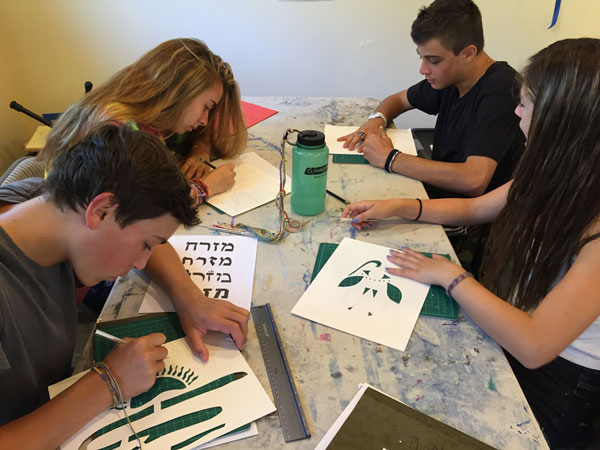
I love papercutting – and I love teaching others to cut paper, leading them to try something new and engage with our tradition in a manner very different from their usual methods. That's why I lead papercutting workshops throughout the year — and why I spend two weeks every summer at URJ Camp Newman doing so with high school-age campers. This summer was my TENTH YEAR at Newman, and a spectacular one.


The Hagigah program at URJ Camp Newman is the premier Jewish arts teen program on the West Coast. Campers choose majors and minors in visual and performing arts, studying with distinguished Jewish artists in an exploratory and collaborative atmosphere.


Their experience culminates in the camp-wide “Mark & Peachy Levy Hagigah Festival of the Arts” to celebrate their work – and the 2016 festival is tomorrow night, July 14. This year, with thanks to Dream Lab and generous support from The Covenant Foundation, I produced a booklet featuring all of the campers' work — to be distributed at the festival to all attendees.


This summer I had 16 campers in my papercutting workshop – two hours every day for two weeks. The campers made some wonderful art, and I'm pleased to share it with you here.


First, the "mizrach" project. Each of the 16 campers made a mizrach (מזרח means "east"). East is the direction that Jews outside of Israel traditionally face during prayer, and a mizrach is an ornamental wall plaque used to indicate the direction of prayer – and that's what the students made, after some group brainstorming about what imagery might work in such an artwork. They were allowed to interpret the idea of a mizrach however they wanted. What I find fascinating about the process is how everyone starts in the same place, with the same goal... but each piece is different, expressing something about the camper-artist who made them.

Dani

Ethan C.

Ethan R.

Hannah

Hannah S.

Jacob

Max

Mia

Noah

Phoebe

Rachel

Sam

Thea

Tristan

Yaron

The second project we do is "paper midrash" – each camper had to identify a story or character from Jewish tradition, and explore and develop it with the aid of knife and paper. Some worked with one of the camp rabbis to find fascinating little tidbits, others made up their own commentaries, and all of them created stunning work. I've included their descriptions of their work in the captions of the photos – their words about their inspiration and process.

Dani: "I wanted a piece that illustrated the forbiddenness of secular music in biblical times. The colours I used are meant to symbolise the beauty that music — religious or not — can bring to the world."

Ethan C.: "I chose the story of the burning bush because I thought that it was interesting that ‘the bush burned with fire, and the bush was not consumed’ [Exodus 3:2]."

Ethan R.: "Judah ben Tema said, ‘Be fierce as a leopard, light as an eagle, swift as a gazelle, and strong as a lion to do the will of our Father in heaven’ [Mishnah Avot 5:20]."

Hannah: "I designed a mezuzah that has the Tree of Life in it. At the base is a pomegranate, which represents mitzvot. The tree then branches out with a Star of David, which represents Judaism. The mezuzah is being hung over the city of Jerusalem to remind us that Jerusalem is always our home."

Hannah S.: "My midrash is a depiction of the creation of night and day [Bereshit 1:4].
I like the idea of the sun and moon because they are everyday things we see, but don’t fully understand."

Max: "This piece is a representation of the idea that everyday is a new opportunity to improve your life. Your future is constantly changing and each day is a new chance to change who you are or what you will become. Each ray of light of the sun is a different shade and design of red, yellow, orange, or purple. This is a symbol for how each day is different. It’s up to you whether or not the day is good."

Mia: "This is my representation of Eve. She is surrounded by green to show her in the Garden. She is holding a pear instead of an apple, showing that she is good and not evil, as she is often portrayed to be. Pears represent motherhood and love. Eve stands alone in this piece because she is usually shown as simply being Adam’s partner, but this shows that she does not necessarily need a man to complete her."

Noah: "I was interested in how Judaism teaches about death and mourning. I thought it was interesting that Jews were virtually the only ancient people to forbid cremation. As Jews, we don’t let ourselves forget the dead. This is why I wrote ‘Never Forget’ and ‘zichronam livracha’ which means ‘Let Their Memory Be For a Blessing.’ We also recognize that life is ending like a flame. This is why I chose to put darkness in place of the flame, while the candle still stands like the body we refuse to cremate."

Peyton: "I chose to do my midrash on an olive branch and dove. When I was trying to figure out what I should do my piece on I read about how olive branches signify peace, and in the Noah’s Ark story — when the flood is over —a dove brings Noah an olive brach signifying peace and that the flood is over and a new life is waiting [Bereshit 8:11]. I love the story and I think peace is a great thing and I wanted to show that in my art."

Phoebe: "The Babylonia Talumd tells us, ‘When a boy was born, it was custom to plant a cedar tree; and when a girl was born, an acacia. When they wed, the tree [planted at birth] was cut down and the wedding canopy made from its branches.’ I believe this tradition is so beautiful. The idea that two separate trees are planted and then brought together is so amazing, and what love should be about: two people coming together. I decided to depict an acacia and cedar branch, both with different coloring. I put a heart in between as a symbol of love, and backed it with a comic in which two people in love were holding hands."

Sam: "As a kid, I always loved the song, ‘There’s a Dinosaur Knocking at My Door, [and He Wants to Have Shabbat with Me]’ and every time I think of that song, I get nostalgic."

Thea: "I chose the creation/separation of night and day for my midrash [Bereshit 1:4]. I chose this theme because I think the sun and moon are very pretty. By using this story, I could incorporate the sun and moon into my art."

Tristan: "I decided to create my piece on lightning, because it has always fascinated me. R. Berekhiah the Priest said: ‘Lightning is something generated by the fire from on high. Hence, when it goes forth, its light illuminates the world from end to end.’"

Yaron built an ark to house the Torah – an original design, backed with super hero comics.


I'm so proud of these campers – they created such beautiful, meaningful work. Yasher koach to all of them!


Thursday, August 8, 2013

Art at the Israel Museum in Jerusalem

Saw a lot of great art in Israel, and took a lot of photos to share out here on my blog. This post has some from my trip to the Israel Museum in Jerusalem.

Much of this is fairly contemporary, though some of it is a bit older ("Modern"). Some comments included with each photo – please let me know what you think, especially if you have details on related work.

This is a work by Raffi Lavie from 1969 called "Untitled." Yeah, more Modern than contemporary. It's acrylic, pencil, and collage on plywood. I love the stylistic connection to abstract expressionists and the collage work of those Paris guys... and there are hints of things that Basquiat later did in New York.


These next two paintings are from a special exhibit on the Fauves. The top one is a Kandinsky from 1908 called "Mountain Landscape with Village I"; the lower one is from Gabriele Münter, around 1910, called "Sunset over Staffelsee." I love the wild colors. The most well-known Fauve work is arguably Matisse's portrait of his wife, "Woman with a Hat."


I love Man Ray. And getting to see the back of "Indicateurs," which he hand-titled and signed, was a thrill for this art geek.


The Israel Museum has a great collection of Judaica, and one of my favorite pieces is this all-in-one set of ritual objects designed by Zelig Segal in 1983, entitled "Holiday Set." At the top is a Hanukkiah, there's a Havdalah set on the right, an etrog holder on the left, Shabbat candleholders at the bottom...


The last piece I'm sharing in this post is the view from inside James Turrell's "Space That Sees" from 1992 – possibly my favorite sculptural work of all time. One enters a big white box (20' square? 30'?) and looks up through an opening to watch the sky above. It's sculpture in reverse, almost. I see it as an exploration of how we frame the natural word to create art – painters and photographers try to capture moments, sculpture tries to replicate it... and this frames the source itself.