[This post was co-written with my wife, Rabbi Shawna Brynjegard-Bialik, and is also posted on her blog, which can be found at
www.TorahGeek.com. Photos are courtesy Rabbi Rick Winer and Bill Leifer.]
It is always a privilege and pleasure to worship and create in a new community — making new friends, gaining new insights, and bringing new works of art into being. This past weekend was such an experience, when we joined
Temple Beth Israel of Fresno as the scholar and artist in residence for their 2017 Shabbaton retreat (in Wonder Valley, California).
The heart of the weekend was “praying with knives” — meditating on the Saturday morning prayers and then using knife and paper to explore their meanings.
 |
| Encouragement from Rabbi Shawna Brynjegard-Bialik |
In our Shabbat morning worship Rabbi Shawna encouraged worshippers to
choose a prayer that intrigued them, reflected a personal experience,
or spoke to how they were feeling right then, and to focus on it during
personal silent prayer: to read it more than once, to connect with the
language, to read it slowly to pull out meaning, to imagine what words
they would use if they were writing the prayer, to see what images came
to mind when reciting the prayer, to meditate on the feelings that it
invoked. And when our service finished, we began to pray with knives.
 |
| Guidance from me |
After
a bit of guidance from Isaac on approach and technique, and a little
experimenting with their knives, the worshippers began to wrestle with
their prayers — first sketching out some basic ideas, and than
translating that idea to a papercut design.
 |
| Mark and Cindy, hard at work! |
No two creations were
the same, even when people chose the same prayer. Several people used
rays of light in some fashion, but each time it was a part of a
different prayer. A few people asked us to figure out which prayer they
were working on based on the images they were trying to convey in their
sketch, in a pictionary-meets-prayer sort of moment.
The prayer
book was explored in its entirety — worshippers weren’t limited to the
standard prayers that compose a service, but also explored psalms,
readings, quotes and songs in the artwork. The lines that we often skip
over because they are placeholders were sometimes the inspiration that
reached out and grabbed someone.
 |
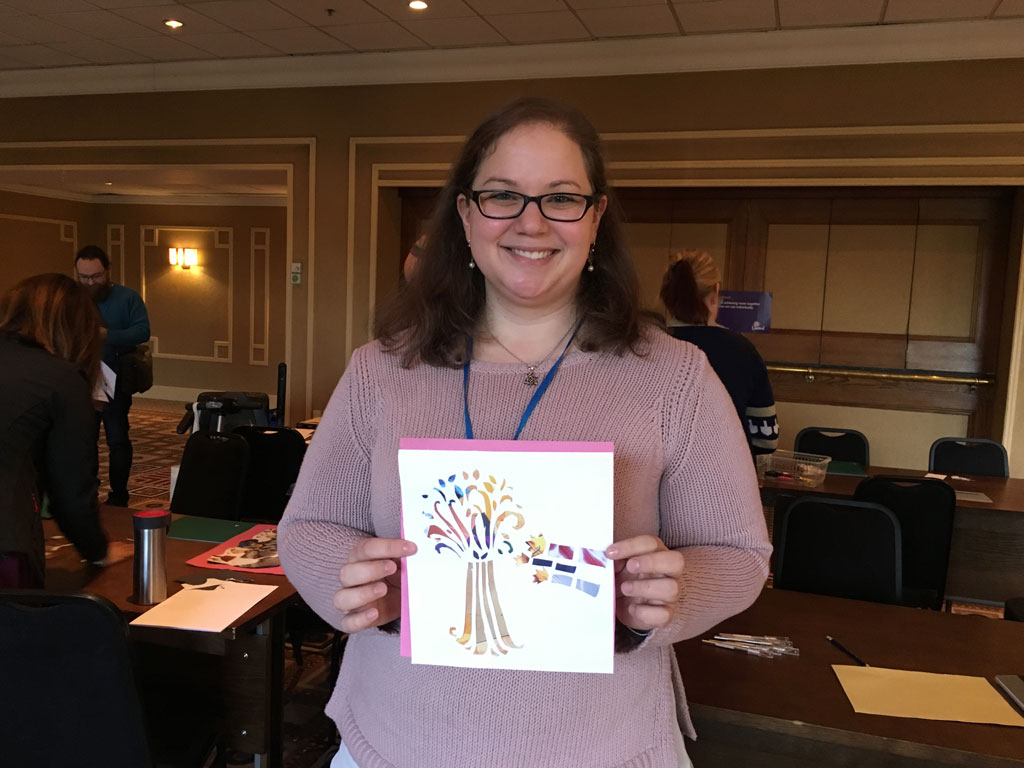
| Rabbi Laura Winer shares her papercut prayer. |
At the end of the Shabbaton on
Sunday everyone had a chance to share their artwork. Prayer by its
nature is personal, and it can be a vulnerable moment to share a piece
of artwork based on prayer, even among friends — but so many people
wanted to stand up and share what they had created. The art and stories
took prayer to a new level; for some they had a favorite prayer that
they were excited to represent, for others something just caught their
eye.
 |
| Side-by-side with the prayer that inspired it. |
We so often think of prayer as written, as the recitation of
words written on a page. But all written prayer started out as
someone’s inner thoughts — as a spontaneous moment of prayer — and over
the years became a part of our standard worship service. In Hebrew
school we often begin by teaching prayers; mastering them in Hebrew is
often a requirement for bar or bat mitzvah. But beyond familiarity with
the words of others, prayer is our attempt to express our deep yearning
or to articulate our gratitude or to help us shift our own perspective,
and we are able to do those things through art. In their creations
participants expressed gratitude, their dedication to helping others,
their appreciation for the people in their lives, looking inward,
creation.
The retreat coincided with the Torah portion Vayekiel,
in which we learn that God assigned Bezalel to create the mobile
tabernacle — the mishkan — and the objects that go with it. Bezalel is a
craftsman skilled in many art forms, but we learn that each of the
Israelites has something to contribute to the creation of the mishkan.
God is the ultimate Creator — the Torah begins with divine creation,
culminating in the creation of human beings in God’s image — but we have
the ability to create as well, and when we do we are connecting with
the Divine within ourselves.
[For more information on how you can bring "the dynamic duo" to
your community, please contact me via email: isaac@nicejewishartist.com.]




 Posts


