Thursday, September 17, 2020

Studio Stories – Kol Haot


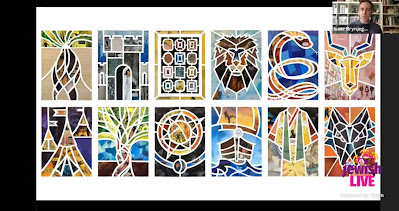
​As the global health pandemic continues to change artists’ lives and practice, Chicago-based artist Lilach Schrag is sharing stories of how artists have adapted to lockdown and the new reality, in a series called “Studio Stories 2020,” hosted by Kol HaOt. This week they profiled my work during lockdown, including my golem series and how Rabbi Shawna and I have been trying to keep Paper Midrash going. Check it out!

Sunday, July 26, 2020

Wisdom Cries Out in the Streets

Inspired by the words of Proverbs (1:20) and the streets of Portland, this is my latest papercut: "Wisdom Cries Out in the Streets."

It's made with cut-up comics featuring super hero moms, including Jessica Jones, Jessica Drew (Spider-Woman), Greer Nelson (Tigra), Sue Storm (the Invisible Woman), and Jubilation Lee (Jubilee).

The "wall of moms" we're seen in the news lately – with moms in yellow, linking arms to protest police brutality, federal kidnappings, and to promote the obvious truth that BLACK LIVES MATTER – is a wonderful visual, and made me think of the words we read in the Book of Proverbs, in which Wisdom is personified as a woman crying out in the streets to be heard.

Wisdom Cries Out in the Streets
24" x 18"
Cut-up comics
2020

Sunday, June 14, 2020

Yearning to Breathe Free


Yearning to Breathe Free
9" x 12"
Mixed media
2020


This past Friday night my wife and I were praying (virtually) with Temple Beth Israel of Fresno, listening to the words of Rabbi Rick Winer, when I had this idea: combining the grief we have at the words "I Can't Breathe" with the hope in these words from Emma Lazarus' poem, "The New Colossus" – found in its entirety at the foot of the Statue of Liberty.

"Yearning to Breathe Free" is made with X-Men comics featuring Bishop – a mutant from the future who is the son of Aboriginal refugees who fled to America, where he was sent to a mutant concentration camp and branded with an "M" over his right eye, used to identify mutants in his era. Which is a lot of backstory, I know.

The words form a tight square on the lower half of a rectangular sheet – I wanted them to feel cramped and in need of release. And the all caps letters in multiple colors? We've seen a lot of that in the streets of America these days, so it's certainly got protest and pride as inspiration as well.

Sunday, May 31, 2020

Black Lives Matter

Tzedek Tzedek Tirdof – Justice, Justice You Shall Pursue!
(Devarim/Deuteronomy 16:18)

#blacklivesmatter #justiceforgeorgefloyd

I Can’t Breathe
24" x 18"
Mixed media
2020

“I Can’t Breathe” is made of cut-up comic books and inspired by the death of George Floyd – and also the Ten Martyrs of the Jewish tradition, and the “Ayleh Ezkerah” poem from our High Holy Day machzor that reminds us to remember those that died in holy causes. I also referenced the Book of Lamentations – particularly thinking about how we represent and respond to tragedy. I’m also a big fan of Ben Shahn (mid-20th century social realist), and his illustrations are definitely an influence on the final form of this piece. Then, once cut, I filled it with cut-up comics books featuring Black super heroes: the wrongly-convicted Luke Cage, the monarch Black Panther, and the youthful Cloak. The color scheme of the figure is actually inspired by Luke Cage’s traditional super hero outfit. The last element in here that might benefit from explanation is the listing of place names in his shirt – taken from an ad for a series of comic book conventions around the country. I saw “Minneapolis” and instantly decided to incorporate it and the other cities, to represent that this is more than one man in one city, but a tragedy we have seen repeated so many times, to so many people, in so many cities.


UPDATE

Featured in the June 4, 2020, issue of LA Weekly.


Sunday, May 17, 2020

Hineini: A Papercut Commission

Hineini: The Ordination of Meir Bargeron
“Hineini” was commissioned for Meir Bargeron by his husband Jon to mark his 2020 rabbinic ordination from Hebrew Union College-Jewish Institute of Religion.

Designed to complement their ketubah, the commission has at its top a similar lattice-like design, filled with comic book speech bubbles that tell a “Hineini “narrative, a call-and-response to inspire us to action.

The lattice at the top evokes a roof, and matches the top of Meir and Jon's ketubah.

Exodus 40:38 and Numbers 9:15-16 indicate that the Pillar of Fire and Pillar of Cloud which protected the Israelites on their journey through the wilderness were actually one pillar — during the day the cloud was visible, and at night the fire inside was revealed. With this in mind the lattice sits on this singular Pillar of Cloud and Fire, source of Divine protection and symbol of God’s sheltering presence, styled in similar fashion to the Havdalah candle in Meir and Jon’s ketubah. The fire within is also a reference to Kedushat Levi, Exodus, Mishpatim 11, in which we read that serving God through observing the commandments and studying Torah gives satisfaction to God, and we experience God’s satisfaction as a burning fire of enthusiasm and inspiration in our heart — and that the “consuming fire” mentioned in the biblical account of the Revelation at Mount Sinai is not a description of what was visible on the mountain, but rather a reminder of this fire within us.

At the center is Meir as Avram (or perhaps the other way around) — a “Hineini” moment in which Meir gets his calling from the Divine. Inspired by the Torah which Meir has taught in sermons and in his thesis, it evokes the experience of ordination which — though it may not be where expected — is nonetheless transformative. Beneath Meir is a foundation of texts from which he has drawn his teachings: stories of Avraham and Sarah, Jacob becoming Israel, Ruth and Naomi, and more; these texts form the Hebrew word “Hineini.”

The Hebrew word "Hineini" is filled with texts from Rabbi Meir's thesis and sermons.
Beneath the texts are tall stands of wheat and barley in the style of Frank Lloyd Wright stained glass. Wheat and barley are two of the seven species (connecting back to the grapes and pomegranates in Meir and Jon’s ketubah); they are a reference to the fields that Ruth and Naomi gleaned together; and they also allude to the many Jewish texts that use wheat and barley as metaphors for growth and morality. Within the stalks can be found maps which point to the past (Minneapolis), the present (Los Angeles), and the future (Fort Wayne).

Wheat and barley and traditional Jewish metaphors for growth and morality.
The Superman panel in which he proclaims, “It’s me” is from the most recent Superman storyline, in which he reveals his truth to the world: he is both Superman and Clark Kent. In issue 18 he says, “When I show up as Superman, I want to show up representing both parts of me at the same time.” It is a bold story about truth and authenticity. He is declaring his identity and his purpose, and responding to a call for action with his whole self — the perfect story to mark Meir’s rabbinic ordination.

The "social distancing" hand-off.

Comics in "Hineni" include:
Action Comics #687 (June 1993) — “Look! Up in the sky!!”
Blackest Night: The Flash #1 (February 2010)
Bucky Barnes: Winter Soldier #1 (December 2014)
Detective Comics #936 (September 2016) — “There’s a call for you.”
Etc #1 (1989)
Eternals #10 (July 1986) — “I am here.”
Fantastic Four #587 (January 2011)
Flash #0 (October 1994) — Story called “the beginning of tomorrow”
The Flash: Rebirth #1 (June 2009)
The Flash #1 (June 2010)
JLA Secret Origins (November 2002)
Justice League International #35 (February 1990)
Kabuki: Reflections #6 (June 2006)
Secret Origins #7 (October 1986) — “Oh...My...God...!”
Shazam: The Power of Hope (November 2000)
Silver Star #1 (February 1983) — Jack Kirby
Superman: Peace on Earth (January 1999) — Krypto (for Charlie)
Superman #18 (February 2020) —Superman reveals his truth
Superman: Heroes #1 (April 2020) — “It’s me.”
Ultimate X-Men #63 (November 2005)
Texts include:
Genesis 12:1 — “Lech Lecha”
Genesis 17:5 — Avram becomes Avraham
Genesis 32:29 — Jacob becomes Israel
Exodus 3:4 — “Hineini”
Mah Tovu — Jacob’s tents
Exodus 18:19 — Yitro and Moses
Ruth 1:16 — “Wherever you go, I will go with you”

And today we had a virtual gathering over Zoom to celebrate Meir's ordination, at which the commission was presented. Mazal tov, Rabbi Meir Bargeron!


Sunday, March 22, 2020

How Can We Serve God with the Works of Our Hands?

[This post originally appeared on ReformJudaism.org]

This week, as we begin the Book of Leviticus with Parashat Vayikra, we read about the eternal flame in the Temple in Jerusalem — a symbol of God’s Presence amidst the Jewish people. The smoke rising from the altar was a remnant of our communications with God — physical evidence that we had engaged with the Eternal.
Cantor David Berger writes that “As moderns we have fully embraced the transition from Temple service to ‘the service of the heart,’” citing Babylonian Talmud, Taanit 2a:
To love the Lord your God and to serve Him with all your heart” (Deut. 11:13). Which is the service of God that is performed in the heart? You must say that this is referring to prayer.
We could take this to mean that as we no longer make physical sacrifices, rather than serving God with our hands, we serve with our hearts and minds. And yes, we have transformed Judaism — the work of our hands, turning substance into flame and smoke became the work of our minds, turning words into music and praise. But where does that leave our hands? I suggest that we still have the power — and the responsibility — to serve God with our hands.

The altar smoke — “of pleasing odor to the Eternal” (Lev. 2:9) — is akin to a finished work of art created by a painter or sculptor. It is the lingering echo of music after an orchestra plays or the warmth of a room that has been filled with dancers exercising their bodies. A painting is the evidence that we have painted — and art about the Jewish experience is evidence of our efforts to commune with our people across time, and with the Divine.

The Jewish-American artist Barbara Kruger said, “Making art is about objectifying your experience of the world, transforming the flow of moments into something visual, or textual, or musical, whatever.” When we use the work of our hands in concert with the work of our minds, we can transform our personal experience of the world and the Divine into a shared moment — into a part of the continuing conversation that has been part and parcel of Judaism since the Divine creation of the world.

Our history reveals a continuous connection between art and Jewish practice — from the carving of the Ten Commandments in the moments before the first Shabbat at the end of Creation (Pirkei Avot 5:6) to Bezalel leading the Israelites in the building of the desert Mishkan (Ex. 35), to the commandment of hiddur mitzvah, “beautifying the commandments.” In Midrash M’chilta d’ Rabbi Ishmael,it says:
“I shall glorify God in the way I perform mitzvot. I shall prepare a beautiful lulav, beautiful sukkah, beautiful tzitzit, and beautiful tefillin.” (Shirata, Ch. 3). The Talmud adds, “a beautiful shofar and a beautiful Torah scroll which has been written by a skilled scribe with fine ink and fine pen and wrapped in beautiful silks” (Shabbat 133b).
Our hands still can — and must — do the work of connecting us to the Divine. We can paint, draw, weave, cut, carve, and inscribe — in the service of our people and the Eternal. We can tell our story, praise God, and promote the ideals of tzedakah, emet and shalom.

"Altar Flame" and "Altar Smoke"
[click to enlarge]
 In my work as a papercutter I am in constant engagement with this task, cutting up and collaging comic books and other found materials and using them as a lens through which to study Torah and make “paper midrash.” My papercuts “Altar Flame” and “Altar Smoke” are two explorations of this week’s parashah: attempts to find meaning in superseded ritual practices.

Both of these papercuts reflect the connection between the Jewish people and the Divine, in ancient and modern practice. Within the flames rising from the altar can be found Phoenix, a superhero member of the X-Men with godlike powers, as well as Wonder Woman, whose story is one of constant back-and-forth between gods and human beings. Tucked into the sacrificial smoke are comics featuring godlike heroes like Superman and Thor and also very human heroes like Batman. Our narratives about the relationships of these super-powered beings, and how they connect with the people around them, an inform our ideas about our relationship with God. We ask ourselves what it means to communicate directly with the Divine, and for what purpose we praise God with our hands and hearts.

Jews have always made things of beauty — for ritual and observance, and also to inspire people and praise the Divine. The work of our hands is vital to the work of our souls.

Wednesday, February 19, 2020

Paper Midrash in Lafayette (no, not the one from Hamilton)

Just wanted to quickly post a few photos from our Paper Midrash residency at Temple Isaiah in Lafayette, California. Rabbi Shawna and I gave a visual sermon on "People of the Comic Book" and we used our "Paper T'filah Visual T'filah" for Friday night services, had an oneg Shabbat scavenger hunt with some of my work, led an adult papercutting workshop, and even had the religious school get into the fun with our exclusive "Fold-and-Cut Torah" lesson plan!

"Paper T'filah Visual T'filah" in Erev Shabbat services


Oneg Shabbat Scavenger Hunt


Making Paper Midrash with Rabbi Shawna


Rabbi Nicki Greninger made Paper Midrash in our workshop

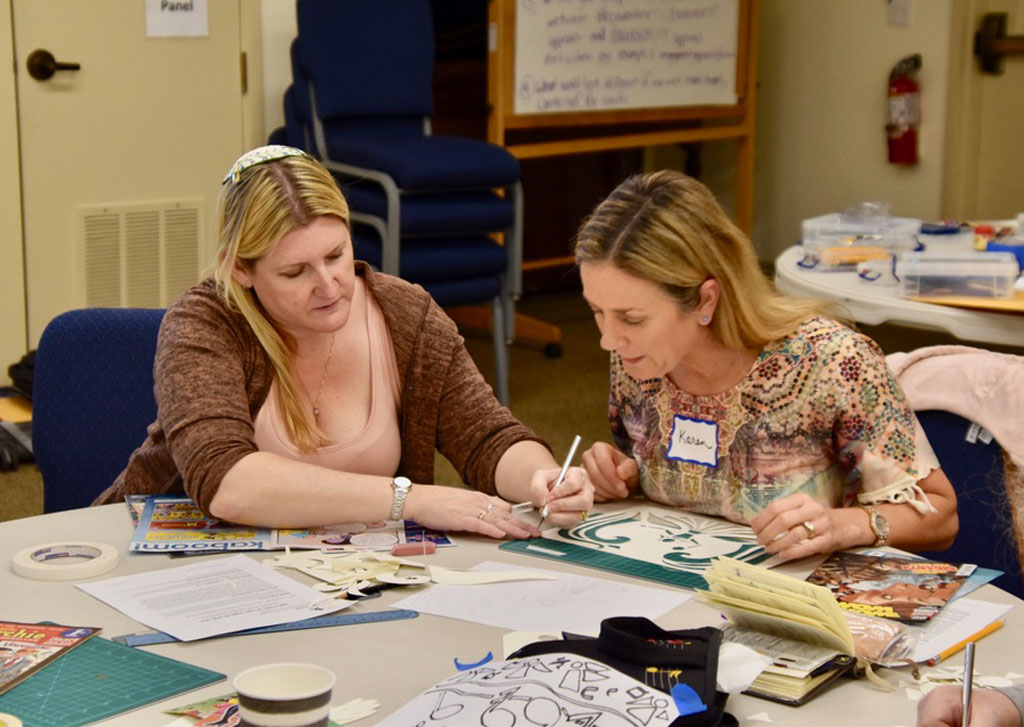
We had a great group in our adult papercutting workshop

Paper Midrash made by Karen, a workshop participant

Paper Midrash made by Nathan, workshop participant

Paper Midrash made by Rabbi Greninger

Tuesday, January 21, 2020

Men of Steel and Women of Valor

This fall I opened a new exhibition at The Temple Museum of Jewish Art, Religion, and Culture in Cleveland called "Men of Steel and Women of Valor," and I've been keeping you posted here (and on Facebook, and Twitter, and Instagram) but as the exhibition comes to a close it seemed appropriate to put everything up in one place – right here on my blog. (You can also read about it in The Forward or the Cleveland Jewish News.)
Standing in the gallery – in my Superboy shirt, of course.


At the heart of the exhibition is a series of large portraits made of cut-up comic books featuring Superman and Lois Lane, Daredevil and Elektra, the Fantastic Four — transformed into the biblical patriarchs and matriarchs, as well as modern figures. These portraits are a nod to the Jewish custom of inviting guests into one’s sukkah during the fall festival of Sukkot, since we opened the exhibition just before Sukkot. In fact, Rabbi Shawna and I went to The Temple-Tifereth Israel for a Paper Midrash weekend to coincide with the exhibition, praying and teaching and creating all weekend with the community.

Rabbi Shawna and I led a bunch of papercutting workshops during our Paper Midrash weekend

We led a number of projects to create new art for the walls of the TTTI sukkah

Teaching in "the birthplace of Superman"


The exhibition focused heavily on Superman, created in Cleveland in the 1930s by two Jews, Jerry Siegel and Joe Shuster — portraits of whom are included in the show, made of cut-up Superman comics from the past 90 years. You can see the whole show online in this PDF catalog, or check out the pix below.
"Abraham: Ignition" is made with cut-up Fantastic Four comics featuring patriarch Reed Richards

"Sarah: Forward" is made with cut-up Fantastic Four comics featuring matriarch Sue Storm Richards

"Isaac: Hurt" is made of comics featuring blind vigilant super hero Daredevil

"Rebekah: Someone" is made of comics featuring ninja badass Elektra

"Jacob:Disguise" is made of Clark Kent comics (and a little bit of Loki)

"Leah: Suppress" is made of comics featuring Lois Lane (and so is her sister)

"Rachel: Answers" is made of comics featuring Lois Lane (and so is her sister)
It also included portraits of Golda Meir, Israel’s first female prime minister, and Sally Priesand, America’s first female rabbi. The portraits share the walls with landscapes of Jerusalem, stories of fire and water and cloud, and explorations of the Mishnah — all made out of cut-up comic books.

“Siegel: Chutzpah” is a portrait of Jerry Siegel, the writer who co-created Superman. Siegel is represented with cut-up comics featuring some of my favorite Superman writers from the past 90 years.

“Shuster: Action” is a portrait of Joe Shuster, the artist who co-created Superman, Shuster is represented with cut-up comics featuring some of my favorite Superman artists from the past 90 years.

“Priesand: My Turn” is a portrait of the first woman to be ordained as a rabbi in the United States, Sally Priesand.

“Meir: Fight” is a portrait of Golda Meir, the first woman to serve as Prime Minister of Israel.


You can see the whole show online in this PDF catalog. For more information on our residencies and workshops, visit PaperMidrash.com.


Wednesday, January 1, 2020

Deep Space Shiviti


“Deep Space Shiviti” is a papercut I created for Rabbi Paul Kipnes in December 2019, commissioned as a birthday present by his family. It is modeled on the traditional Jewish shiviti, a meditative artwork inspired by words from Psalms 16:8: “I have always placed the Eternal before me,” intended to inspire an appropriate frame of mind for prayer and contemplation. The shiviti traditionally incorporates a seven-branched menorah, words drawn from Jewish texts, kabbalah, and other mystical sources; this one also features cut-up comic books.

“Deep Space Shiviti” is a contemporary and personal interpretation of this traditional form, built around a vision from the fourth chapter of the book of Zechariah, which describes a lampstand of gold, feeding into and being fed by two olive trees, one on either side. It is a vision of replenishment and renewal, of resilience and rededication. Surrounded on both sides by the twelve gems of Aaron’s priestly breastplate (an allusion to Rabbi Kipnes’ Hebrew name), the menorah stands in front of the Kotel in Jerusalem, reinvented as a place where everyone stands together for inspiration and connection.

The words and imagery in “Deep Space Shiviti” are drawn from comic books — two kinds in particular: Star Trek comics and comics featuring Jewish super heroes. The name “Deep Space Shiviti” is itself a reference to Rabbi Kipnes’ guest appearance on an episode of “Star Trek: Deep Space Nine.”


There are allusions to Rabbi Kipnes’ family and community; to places close to his heart; to his roles as husband, father, rabbi... and as a man true to himself. The papercut contains camp cabins, maps of wondrous places, and images of light and inspiration.

There is the Bat Signal, another lighted symbol of hope; Yggdrasill, the “world tree” whose roots and branches support and connect the fabled Nine Realms; and Deep Space Nine, a home to a diverse group of people with different backgrounds who are united in a common cause (and also of special meaning to Rabbi Kipnes). The papercut also features multiple Jewish super heroes, including Kitty Pryde and Benjamin “The Thing” Grimm — the former with her “Hold Fast” tattoo and the latter holding his Star of David necklace; Black Canary, whose commitment to heroism is matched by her commitment to handing down her super heroic beliefs and practices to the next generation; and Spider-Man, who reminds us that with great power must also come great responsibility.

The papercut includes:
All-New X-Men #13 (Aug 2013)
Astonishing X-Men #36 (Apr 2011)
Batwoman #3 (Jan 2012), #16 (Mar 2013)
Booster Gold #19 (Jun 2009)
The Life of Captain Marvel #1 (Oct 2018)
Dazzler #38 (Jul 1985) – “Light”, #1 (Aug 2018)
Excalibur #66 (Jun 1993)
Fantastic Four #56 (Aug 2002)
The Legion of Super-Heroes #503 (Sep 1983)
Tales of the Legion of Super-Heroes #352 (Oct 1987)
Lumberjanes: A Bird’s Eye View (Dec 2017
Marauders #2 (Jan 2020)
Noble Causes: Distant Relatives #2 (Sep 2003)
The Ray #1 (May 1994)
Scarlet #8 (May 2016)
Star Trek Movie Special: Star Trek III (1984)
Star Trek: The Next Generation #24 (Oct 1991)
Star Trek: Deep Space Nine #1 (Aug 1993)
Star Trek: Year Five #1 (Apr 2019)

Wednesday, November 13, 2019

Paper Midrash in North Carolina

This year, since High Holidays, Rabbi Shawna and I have been in Manhattan (NY), North Hollywood (CA), Cleveland (OH), Milwaukee (WI)... and we're just getting started! This past weekend we were in Winston-Salem, North Carolina, bringing Paper Midrash to Temple Emanuel – and we had a great time, as usual.

Rabbi Mark Cohn leading Erev Shabbat services with "Paper T'filah Visual T'filah"

We started the weekend with a pop-up gallery for an intimate gathering of temple leadership, then in to services which Rabbi Mark Cohn led with "Paper T'filah Visual T'filah" (which I made in cooperation with CCAR Press).


Rabbi Shawna and I gave a visual sermon on this week's Torah portion, which we called "Lech L'cha: Boldly Go," which referenced Abraham and Sarah (of course) but also Star Trek, The Fantastic Four, Captain Marvel, Black Panther, and more.

Saturday morning we led a Paper Midrash workshop, in which participants created beautiful and meaningful midrashic interpretations of Lech L'cha, cutting up comic books just like I do in my studio.


God calls to Abram and Sarai: "Lech L'cha!"

Abraham is a super hero, surviving being thrown into the fire by Nimrod.

Sarah has her own super hero: she talks directly to God and saves Abraham!

Sarah being carried into Egypt by Abraham, disguised as his sister, IN A COFFIN.
 Saturday night Rabbi Shawna and I presented "People of the (Comic) Book," a visual history of Jews and comic books, from the very first comic book in the 1930s up to present-day Jewish creators and characters.


Ready to talk about the patriarchs: Jerome, Joseph, Stanley, and Jacob


It's such a fascinating subject, and we have so much fun revealing the semi-secret Jewish world behind Superman, Batman, the Marvel cinematic universe... so much good stuff.

Religious school students making "Fold-and-Cut Torah" projects in the Lamed Center


Sunday morning we brought our "Fold-and-Cut Torah" project to the Temple Emanuel religious school – Rabbi Shawna and I led a special program for the fifth, sixth, and seventh grade students and their parents, while the K-5 classes used our lesson plan to create their own Torah focused on the values held in common with comic books.

Learning and praying with the "Twelve Tribes" papercuts


Sunday ended with a special service for the religious school led by Rabbi Cohn that incorporated my papercuts, including my "Twelve Tribes" series – so proud to have my work used in this beautiful studying/praying/learning experience!

Want more information about bringing Paper Midrash to your community? Contact us at info@papermidrash.com for details.